

This work by New American History is licensed under a Attribution-NonCommercial-ShareAlike 4.0 (CC BY-NC-SA 4.0) International License. Permissions beyond the scope of this license may be available at newamericanhistory.org.
Cooking Up Discoveries
A collaboration between New American History and Thomas Jefferson's Monticello
Standards
Common Core:RH.9-10.1: Cite specific textual evidence to support analysis of primary and secondary sources, attending to such features as the time and place of publication, origin, authorship, etc. RH.9-10.2: Determine the central ideas or information of a primary or secondary source; provide an accurate summary of how key events or ideas develop within a text. RH.9-10.3: Analyze in detail a series of events described in a text; determine whether earlier events caused later ones or simply preceded them. RH.9.1-0.5: Describe how a text presents information (e.g., sequentially, comparatively, causally, visually, and graphically). RH.9-10.6: Compare the point of view of two or more authors for how they treat the same or similar topics, including which details they include and emphasize in their respective accounts. RH.9-10.7: Integrate and evaluate visual and technical information (e.g., in research data, charts, graphs, photographs, videos, or maps) with other information in print and digital texts. RH.9-10.9: Compare and contrast treatments of the same topic in several primary and secondary sources. C3 Framework:D1.1.9–12: Explain how compelling questions help frame inquiries and give meaning to key issues in history.D1.3.9–12: Identify sources that can be used to address compelling and supporting questions D1.5.9–12: Determine the kinds of sources that will be helpful in answering compelling and supporting questions, considering multiple perspectives.D2.His.1.9–12: Analyze connections among people, events, and developments in broader historical contexts.D2.His.4.9–12: Analyze multiple factors that influenced perspectives of people during different historical eras.D2.His.5.9–12: Evaluate how historical contexts and perspectives shape interpretations of the past.D2.His.12.9–12: Use questions generated about multiple historical sources to identify further areas of inquiry and additional sources.D2.His.16.9–12: Integrate evidence from multiple relevant historical sources and interpretations into a reasoned argument about the past.D3.1.9–12: Gather relevant information from multiple sources while using the origin, authority, structure, and context to guide interpretation.D3.2.9–12: Evaluate the credibility of a source by examining how authors use evidence and reasoning.D3.3.9–12: Identify evidence that draws information from multiple sources to support claims, noting contradictions.D3.4.9–12: Develop claims and counterclaims using evidence while pointing out strengths and limitations.D4.1.9–12: Construct arguments using claims and evidence from multiple sources, while acknowledging counterclaims.D4.2.9–12: Present adaptations of arguments and explanations for different audiences (e.g., digital exhibits, podcasts, essays).D4.6.9–12: Use disciplinary and interdisciplinary lenses to identify actions that address local, national, or global issues.D4.8.9–12: Apply civic virtues and democratic principles when working with others to address historical or contemporary issues.National Council for Social Studies:Themes: 1. Culture & 4. People, Places & EnvironmentsNational Geography Standards: Geography Standard 4: The physical and human characteristics of places.Geography Standard 17: How to apply geography to interpret the past.EAD FrameworkPrimary Theme: Contemporary Debates & PossibilitiesKey Concepts (6-8, 9-12)Explore the relationships between hard histories and contemporary debatesCultivate an understanding of personal interests, motivations, and decisions as civic agentsBuild strategies for learning about current events, issues, and debatesHSGQ7.3A. Why do particular current events and issues matter to you and how can you learn more about them?HSGQ7.3B. Are there moments, themes, or principles in United States history to which you can connect those issues?HSGQ7.3C. Have the American people ever faced a similar problem before? How did they solve it, or make it worse?a
Teacher Tip: Think about what students should be able to KNOW, UNDERSTAND and DO at the conclusion of this learning experience. A brief exit pass or other formative assessment may be used to assess student understandings. Setting specific learning targets for the appropriate grade level and content area will increase student success.
Suggested Grade Levels: Middle School (6-9), High School (9-12), A.P. US History
Suggested Timeframe: Two 45-minute sessions or a 90-minute block
Suggested Materials: Internet access via laptop, tablet or mobile device
Key Vocabulary
Ambition — a strong desire to do or to achieve something, typically requiring determination and hard work
Archaeology — the study of human history by examining artifacts, buildings, and other physical remains; a person who studies this is an archaeologist
Bake oven — a built-in oven, often made of brick or stone, used for baking bread and other foods
Burner — one of the individual heating openings or zones on a stove used to heat pots and pans
Cooktop — the top surface of a stove where cooking takes place; in early America, this included stew stoves
Culinary — relating to cooking or the preparation of food, especially trained cooking techniques
Dresser — a counter or sideboard in a historic kitchen used for preparing, storing, or arranging food and equipment
Ember — a small glowing piece of wood or coal from a fire, used as a heat source in early cooking stoves
Enslaved — forced into labor or service without freedom or pay; at Monticello, enslaved people performed most of the cooking and kitchen work
Explainer - a guidance document, handout or digital content to help learn a new topic or skill
Fireplace / Hearth — the built-in area where wood or coal was burned to heat a home or cook food
Fixture — a permanent piece of equipment built into a room, such as a stove or bake oven
French cuisine — the cooking traditions and techniques developed in France, known for sauces, stews, and refined dishes
Inference — a conclusion reached on the basis of evidence and reasoning
Innovation — something new or to a change made to an existing product, idea, or field, including the practical implementation of ideas that result in the creation or improvements of goods or services
Kitchenware / Cookware — the pots, pans, tools, and utensils used for cooking and food preparation
Layout — the way in which the parts of something are arranged or laid out
Legacy - something important that is passed down from the past. It can be an idea, a skill, a tradition, or even a special object
Masonry — the craft of building structures using individual units—like brick, stone, or concrete block—typically bound together with mortar.
Plantation — a large agricultural estate (especially in the American South) where cash crops were grown, most often using enslaved labor
Power dynamics — who has the most influence, control, or decision-making power in a relationship or group, and how that power is used
Primary source — An original document or artifact created at the time of an event or by a person directly involved, providing firsthand evidence or eyewitness accounts.
Reproduction — an imitation, copy, or replica of an original piece such as a painting, artifact, antique furniture, or even a room or a building.
Restoration — the process of repairing and recreating a historic space to reflect its original appearance and function
Secondary source — a source that interprets, analyzes, or discusses primary sources, providing an interpretation or analysis of the events or people involved
Stew stove — an 18th-century waist-high masonry stove with multiple heating openings that allowed cooks to prepare several dishes at once using charcoal or embers; this was an elite style of cooking used in Monticello’s innovative workspace for preparing meals in the late 1700s and early 1800s
Succession — a number of people or things sharing a specified characteristic or and following one after the other
Transaction / Documentary evidence — written records (letters, inventories, cookbooks, drawings) that historians use to understand the past
Work space — an area arranged for specific tasks; in this context, a kitchen organized for efficient food preparation
Read for Understanding
Teacher Tips:
New American History Learning Resources may be adapted to a variety of educational settings, including remote learning environments, face-to-face instruction, and blended learning. They follow a variation of the 5Es instructional model, and each section may be taught as a separate learning experience or as part of a sequence of learning experiences. We provide each of our Learning Resources in multiple formats, including web-based and as an editable Google Doc for educators to teach and adapt selected learning experiences as they best suit the needs of your students and local curriculum. You may also wish to embed or remix them into a playlist for students working remotely or independently.
If you are teaching remotely, consider using videoconferencing to provide opportunities for students to work in partners or small groups. Digital tools such as Google Docs or Google Slides may also be used for collaboration. Rewordify helps make a complex text more accessible for those reading at a lower Lexile level while still providing a greater depth of knowledge.
Teachers of Multilingual Learners may find that using sentence frames can help ELLs by providing a structured framework that can support them when expressing their ideas in complete sentences, whether they are speaking or writing. It serves as a scaffold for ELLs who struggle with grammar and/or vocabulary while promoting the use of academic language.
The S-I-T: Surprising, Interesting, Troubling protocol allows students to make their thinking visible using a structured table that can help them categorize their thoughts in a clear and precise manner. It also allows students to demonstrate their engagement with the text, as they note their reactions to various parts of the comic. A template is provided for you to modify as needed, for students to make a digital copy, or to print paper copies for your students as needed.
Exit tickets and graphic organizers allow students to reflect on their learning and enhance their communication skills. The Engage, Explore, Explain, Elaborate, and Extend sections of this learning resource include graphic organizers/exit tickets that use See-Think-Wonder, Sketchnotes, S-I-T Strategy, Reciprocal Teaching Discussion Protocol, and Think-Pair-Share for further engagement. Templates are linked within the lesson for you to modify, for students to copy, or to print paper copies for your students as needed.
In preparation for this lesson, teachers may wish to watch this video, Cooking at Monticello, which is long for students but covers how a stew stove works (at 6:15) and much more. They might also want to explore one of the many blog posts on food and drink at Monticello. According to Monticello archaeologists, a stew stove was installed in the first kitchen at least by Period 3 of the first kitchen (1790-1808), although it is possible that there was a stew stove already during Period 2 (1775-1790). Jefferson also planned for stew stoves in his initial architectural designs (c. 1768-1772), likely trying to mirror what he had possibly seen at the residences such as the Governor's Palace in Williamsburg, Virginia. For more information, please see the archaeological report of the South Pavilion (pages 14-15, 20, 23-24, 83-86).
When teaching the Explore section, teachers may want to add a further piece of reading that is linked in the Monticello 1809 Kitchen site: the Spring 2005 Monticello Newsletter article, "Refurbished Kitchen is Opened to Visitors." For the Extend section, students will also use Bunk excerpts. It might be useful to allow students time to explore and familiarize themselves with the website before the lesson, so they may gain a better understanding of the information provided.
When creating the Memory Map:
When students create their Memory Maps, encourage them to keep their work simple and focused, emphasizing that this is a thinking tool rather than an art project. Model a quick example so students understand what counts as a place, a voice, and a change in interpretation related to Caesar’s story, and remind them to pull details directly from the Bunk excerpt or connected sources rather than guessing. As you circulate, prompt students to consider whose perspective is shaping how Caesar is remembered, what evidence helps tell his story today, and how interpretations of enslaved cooks like Caesar have shifted over time. If students struggle, encourage them to choose one strong detail from the reading and build from there. Reassure students that the goal is to visualize ideas quickly to support deeper discussion, not to create a perfect diagram. A simple organizer is provided to assist them in their planning.
If you prefer a digital version of the Memory Map, you may have students use the free Esri K12 online StoryMap platform instead. A district-wide license is free to all K12 schools, or students may sign up for individual accounts, as your school’s Acceptable Use policies permit. Esri offers simple tutorials to help students create an account and explore the StoryMap as their “memory map” reference. Students may scroll through the sections, review the key ideas, images, and maps, and then identify the most important details on their own. They can summarize or sketch their takeaways in their notebooks or a digital tool of their choice.
Additional Extension Activity/Learning Resource:
For teachers who want to deepen students’ understanding of culinary history in the American South, consider using Finding Edna Lewis as an optional extension activity. This multimedia learning resource traces the life and legacy of Edna Lewis, a Virginia-born chef who celebrated and preserved traditional Southern foodways rooted in African American culture. Students will explore primary sources, personal stories, and cultural history to think more broadly about how food traditions carry memory, identity, and community.
In this activity, learners can investigate how Lewis’s work challenges common narratives about Southern cuisine, identify connections between food, culture, and history, and reflect on how food can be a lens for understanding the contributions of historically marginalized groups. This resource offers video, images, readings, and prompts that allow students to extend their learning beyond Monticello’s kitchens and see how culinary expertise shaped regional and national traditions.
For Students:
At Thomas Jefferson’s Monticello the Granger/Hemings Kitchen, and later the 1809 kitchen, was one of the busiest and most important places on the plantation. Archaeologists have learned a lot from studying the remains of the early kitchen’s stew stove. This kitchen is where meals were prepared by enslaved chefs in the late 1700s and early 1800s. The kitchen wasn’t just a room for cooking: it was a highly organized, innovative workspace designed to support Jefferson’s love of French-inspired cuisine, complete with a stew stove - an early version of a modern cooktop that allowed cooks to prepare multiple dishes at once and reflected the household’s wealth. By studying the kitchen and the artifacts found there, historians are uncovering these hidden stories and increasingly have a better understanding of how power, culture, and food were connected in early America – turning the kitchen into a window illuminating the lives and experiences of the people, both free and enslaved, whose work helped build the nation.
Engage:
What can a kitchen scene tell us about the people, technology, and labor that shaped daily life at Monticello?
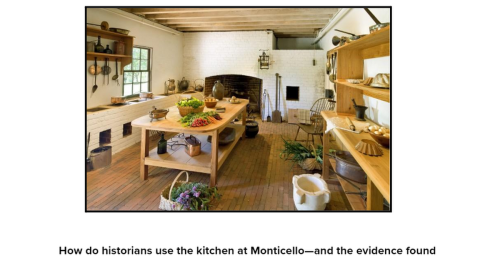
n the late 1700s and early 1800s, the kitchen at Thomas Jefferson’s Monticello was one of the busiest and most important workspaces on the plantation. Enslaved cooks and kitchen workers prepared meals using a mix of traditional techniques and new cooking technologies, including an early type of cooktop called a stew stove. The illustration below is a modern artist’s interpretation based on archaeological evidence and historical records. As you look closely at the image, think about what it can tell us about the people who worked here, the tools they used, and the daily life inside this kitchen.
Making Observations:
Historians and archaeologists often start by asking careful questions about what they have found in archives or through physical investigations. This drawing below was made based on some of the findings. Remembering this is an artist’s idea of what was found, let’s think about what happened in kitchens of the late 18th century and early 19th century at Monticello by looking closely at the details of the image. What is happening in this room? Who is doing the work? What clues do you see?
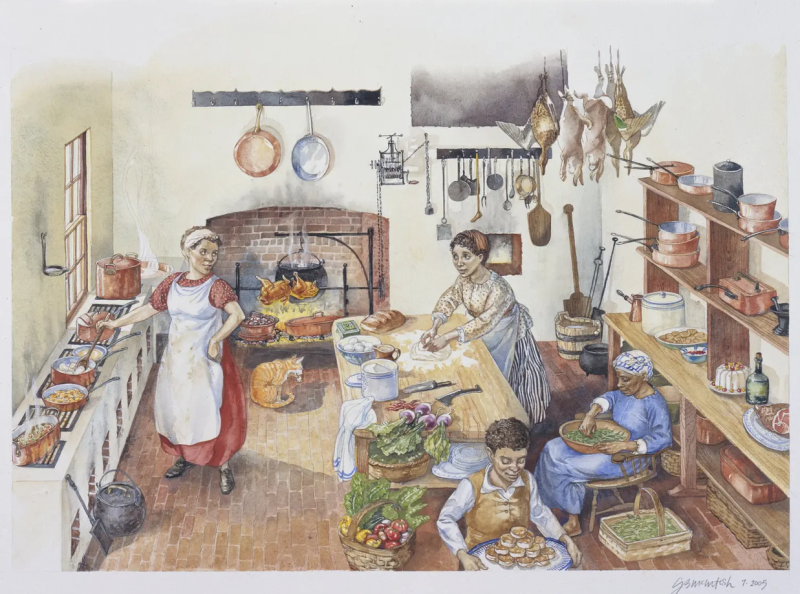
SEE: What do you see? Describe details without interpreting them.
THINK: What do you think is happening here? What clues help you make that inference?
WONDER: What does this make you wonder about Monticello, the technology in this kitchen, or the people who worked here?
Sentence Frames:
SEE:
- I see …
- I am noticing …
- I observe ….
THINK:
- I think that … because …
- It seems that … because …
WONDER:
- I wonder …
- I am curious about …
Use the See-Think-Wonder strategy to jot down and then exchange ideas with a classmate (or two), using this graphic organizer. You may make a digital copy or use a paper copy provided by your teacher.
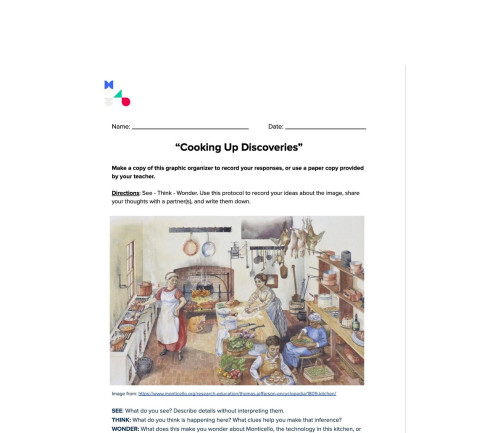
NAH See-Think-Wonder: Monticello Kitchens
Make a copy of this graphic organizer to record your responses, or use a paper copy provided by your teacher.
docs.google.com
Related Readings:
After examining the kitchen image, you will read about the succession of enslaved cooks that worked at Monticello. The original kitchen at Monticello was small and used a hearth for cooking. After Jefferson returned from France in 1789 he had stew stoves installed, as his enslaved chefs had learned to use in France. After returning from his time as president a second, newer kitchen was created at Monticello. If you visit you will be able to see both the archeological evidence of the earlier kitchen, used up to 1808 by the cooks mentioned in the website below, as well as the kitchen reconstructed from evidence and called the “1809 kitchen”. In both kitchens the preparation, cooking, serving and cleanup for the meals enjoyed by Jefferson, his family, and his guests was all made possible by enslaved cooks and their families.
Historical records rarely mention the daily labor of enslaved workers. “Much to Our Comfort and Satisfaction” tells us about a succession of Monticello’s cooks and includes primary sources alongside video and short biographies of Ursula Granger, James Hemings, Peter Hemings, as well as Edith Hern Fossett and Frances Gillette Hernt.
Much to Our Comfort and Satisfaction: Monticello’s Enslaved Cooks
Records rarely mention that the preparation, cooking, serving and cleanup for the meals enjoyed by Jefferson, his family and his guests was made possible by Monticello’s enslaved cooks and their families.
www.monticello.org
The second video “Ursula Granger, Cooking on the Hearth” explains about hearth cooking. The third video “James Hemmings, Creating French Cuisine” explains why the stew stove was so important for his cooking. The web site also describes a day in the kitchen.
These stories can help you better understand the skills, knowledge, and labor behind what you’re observing. As you read, think about what Granger’s, Hemings’s and other stories reveal about cooking, power, and creativity in this time period.
- Based on what you saw, thought, and wondered, what do you think historians might try to learn from these kitchens?
- How do the kitchen image and Ursula Granger or James Hemings, or other Monticello enslaved chefs’ stories together deepen your understanding of who did the work at Monticello—and what knowledge and skill it required?
Your teacher may ask you to record your answers on an exit ticket.
Explore:
How do the design, technology, and archaeological evidence from Monticello’s kitchen deepen our understanding of the people who worked there?
In this part of our inquiry you’ll dig into the real spaces and tools that made food innovation possible at Monticello. By exploring images and descriptions of both the Granger/Hemings kitchen and the 1809 kitchen, and descriptions of Monticello’s experimental stoves, you’ll begin to uncover how cooking, technology, and labor came together in ways that were both groundbreaking and deeply complicated. As you examine these sources, use the S-I-T protocol to identify what you find surprising, interesting, or troubling—and consider what these kitchen spaces reveal about whose knowledge, effort, and creativity fueled discoveries at Monticello.
Watch this video about the Granger/Hemings kitchen’s archaeology.
This video further explains the stew stoves’ construction and how they worked.
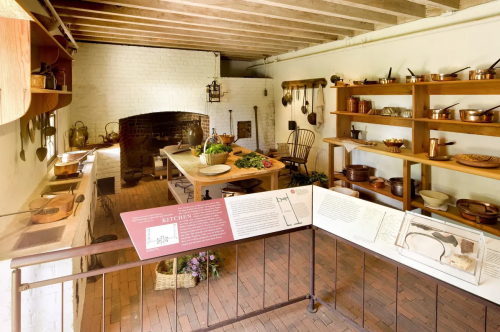
1809 Kitchen
Completed by 1809, Monticello's best-equipped kitchen was the domain of enslaved chefs Edith Fossett and Frances Hern, who brought French-trained culinary expertise to the mountain after serving at the White House.
www.monticello.org
Make some observations about the two photos in this gallery of images of the current exhibits at Thomas Jefferson’s Monticello:
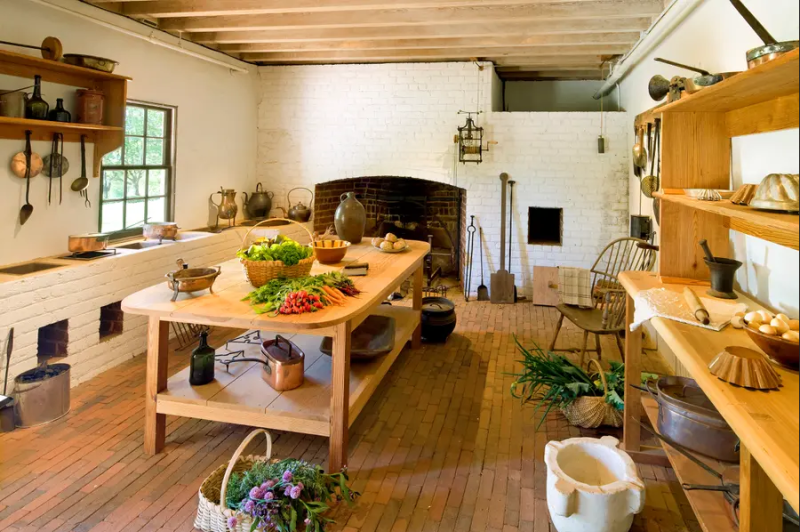
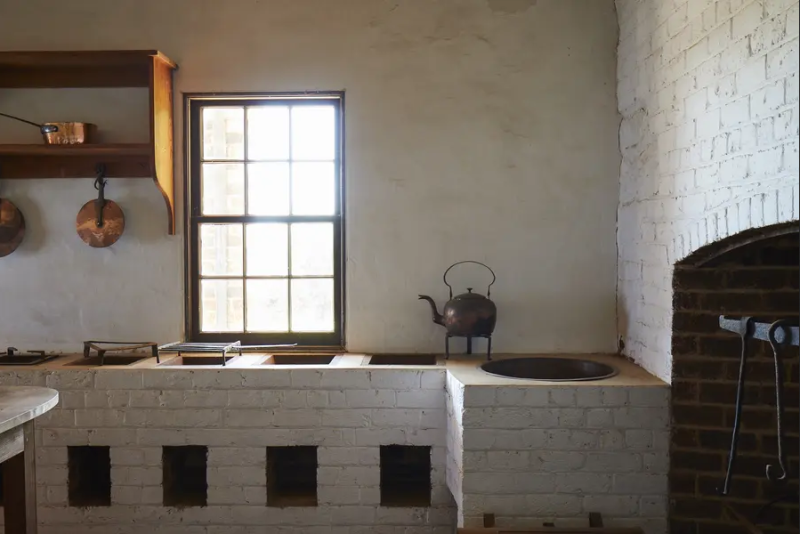
1/2
Consider how the design and tools of Monticello’s kitchens help us understand the innovation, labor, and power dynamics at Jefferson’s estate.
- What features, tools, or design elements of the reproduction 1809 Kitchen stand out to you — and what might those features tell us about how food was prepared there?
- Who worked in these kitchens, and what might the layout and equipment tell us about their skills, roles, and labor conditions?
- Why do you think the kitchens at Monticello were described as “among the best equipped in Virginia”? What does that suggest about wealth, status, and ambition during that time?
- How do either the Granger/Hemings kitchen or the 1809 kitchen compare to modern kitchens? What are some similarities? What are some differences?
Sentence Frames:
- Some of the features, tools, and layout of the kitchen that stand out to me are _____________________.
- This layout and equipment tells us that they must have been __________________, and _________________.
- I think the labor conditions may have been _______________ because ____________________.
- I think the kitchens at Monticello were described as “the best equipped in Virginia” because _____________________.
- This tells us that __________________________.
- These kitchens are similar to modern kitchens because _________________. However, it is different because ________________.
You may take notes using this S-I-T graphic organizer on the information you are most interested in exploring. Your teacher may provide a paper copy of the graphic organizer or allow you to make a digital copy.
NAH S-I-T: Surprising, Interesting, Troubling
Make a digital copy of this chart to record your thoughts, ideas, and answers, or use a copy provided by your teacher. What was SURPRISING? What was INTERESTING? What was TROUBLING? S-I-T: Surprising, Interesting, Troubling
docs.google.com
Your teacher may ask you to record your answers on an exit ticket.
Explain:
How do historians use the kitchen at Monticello—and the evidence found in its tools, layout, and technology—to understand the lives, labor, and innovations of the people, both free and enslaved, who worked there?
You will use the Reciprocal Teaching Protocol in small groups to discuss your understanding of the information you have analyzed so far. Use the two webpages — the 1809 Kitchen and the Much to Our Comfort and Satisfaction page — and your S-I-T reflections. You may use this Cooking Up Discoveries explainer as you take turns asking questions, summarizing ideas, clarifying confusing parts, and making connections.
NAH Reciprocal Teaching: Cooking Up Discoveries
Make a digital copy of this Google Doc to record your responses, or use a paper copy provided by your teacher.
docs.google.com
What Is Reciprocal Teaching?
Reciprocal Teaching is a group discussion strategy where everyone takes on a role to help the whole group better understand information. Each person has a responsibility that supports deeper thinking:
- Questioner – Asks big or tricky questions to spark discussion.
- Summarizer – Gives a quick recap of the most important ideas.
- Clarifier – Clears up confusing words, tools, concepts, or historical references.
- Connector – Makes connections to real life, other class texts, or personal experiences.
By rotating roles and sharing responsibility, you help one another build understanding—and use historical thinking skills to interpret primary and secondary sources together.
Choose Roles in Small Groups
Questioner – Pose deep, open-ended questions to drive discussion.
- Evidence-Based Question:
What specific piece of evidence from the kitchen (a tool, stove, layout, or description) helps us understand how food was prepared or how people worked, and why is it important?
- Interpretation Question:
Why might Jefferson have invested in advanced kitchen technologies, and how might historians interpret what this reveals about life at Monticello?
- Labor & Power Question:
What does this evidence show about the experiences and skills of the enslaved cooks who worked here? What is still unknown?
Summarizer – Identify the main ideas and key points.
- Main Idea:
What is the most important idea you learned about the Monticello kitchens?
- Evidence Connection:
Which pieces of evidence—images, objects, or the webpage details—helped you understand daily life in the kitchen?
- Reflection/Big Picture:
Based on this section, what can we now say about how historians reconstruct the daily routines, technologies, and relationships at Monticello?
Clarifier – Clear up confusing parts or difficult language.
- Term/Concept Clarification:
What words or ideas (e.g., “French-style stew stove,” “hangable pots,” “enslaved labor”) need to be unpacked?
- Evidence Understanding:
Is there any tool, architectural feature, or description that was confusing? How can we make sense of it?
- Context Check:
What background from the Explore section (S-I-T, images, kitchen description, or the stove information) helps clarify this source?
Connector – Link ideas across sources, personal experiences, and the world.
- Text-to-Text:
How does the evidence about the kitchens connect to what we learned from the stoves or the S-I-T protocol?
- Text-to-Self:
Does anything about these kitchens remind you of cooking spaces you know, or of how people use technology today?
- Text-to-World:
How does this kitchen help us understand larger themes: slavery, labor, innovation, privilege, or whose stories are usually centered in history?
Whole-Class Reflection
After your small-group discussions, your teacher may have your class come back together and reflect on these guiding questions:
Evidence and Understanding:
- What new insights did we gain about life and labor at Monticello from studying the kitchens, and how did different types of evidence help us understand it?
Historical Thinking:
- How do historians interpret physical spaces and tools to understand people’s lives, especially when written records are limited or biased?
Broader Significance:
- Why is it important to study places like kitchens—and the people who worked in them—when learning about American history?
Sentence Frames
- From the evidence we examined, I learned that the Monticello kitchens ____________.
- This evidence helps us understand the lives of the people who worked there by ____________.
- Historians use tools, spaces, and technology as evidenced by ____________.
- One challenge historians face when studying daily life at Monticello is ____________.
- Understanding the kitchens changes the way we think about Monticello and Jefferson because ____________.
Final Reflection:
What is one important concept you learned about how historians use physical spaces—like the Monticello kitchens—to reconstruct the daily lives, labor, and innovations of the people at Monticello?
Your teacher may ask you to record your answers on an exit ticket.
Elaborate:
How can we use historical evidence to elaborate on the story of Monticello’s kitchens in ways that center the skills and labor of enslaved cooks?
Curators, directors and interpreters at museums and historic sites often decide whose stories are told. Exhibits in historic spaces reflect different stories depending on the choices of the people who interpret the space. In this activity, you will step into the role of a museum curator and write a kitchen exhibit label for Monticello's 1809 Kitchen. Using evidence from the sources you’ve explored, you’ll create a label that highlights both the technology of the kitchen and the knowledge, labor, and creativity of the enslaved cooks and kitchen workers.
Your Task:
Write an expanded/alternate museum label (150–200 words) for Monticello’s 1809 Kitchen or the Granger/Hemings Kitchen exhibit that enhances the history and significance of this place. You may use these directions and the Task Card provided to write your museum label.
Your label should:
- Explain how 19th century kitchen technology worked (especially the stew stove)
- Highlight the skills, labor, and expertise of enslaved cooks
- Use at least two specific pieces of historical evidence from the readings, images, or discussions
- Explain why this history matters today
Think like a historian and a storyteller:
Your goal is not just to inform, but to help visitors understand whose knowledge powered innovation and why that matters.
Checklist (Use Before Submitting)
- My label is 150–200 words
- I clearly describe one kitchen technology (stew stove, layout, tools, etc.)
- I explain the role and expertise of enslaved cooks or kitchen workers
- I use at least two pieces of evidence from our sources
- I explain why this story is important or how it influences what we think about Monticello
- My writing is clear, organized, and written for a public audience (museum visitors)
Your teacher may ask you to record your answers on an exit ticket.
Extend:
Why does it matter how we remember and tell the stories of enslaved cooks and innovators like those who worked in Monticello’s kitchens?
So far you have explored how historians have used kitchen spaces, tools, and evidence at Monticello to better understand the lives and labor of enslaved cooks. But Monticello was not the only place where enslaved people used skill, creativity, and expertise in the kitchen. In this activity, you will extend your thinking beyond Monticello by examining the story of Caesar, an enslaved chef and master chocolatier at Stratford Hall in Westmoreland County, Virginia (owned by the Lee family). You will consider how stories like his are remembered—or forgotten—and why it matters how we tell these histories today.
Read this Bunk excerpt, “Oppression in the Kitchen, Delight in the Dining Room,-- The Story of Caesar, and enslaved chef and chocolatier in colonial Virginia.”
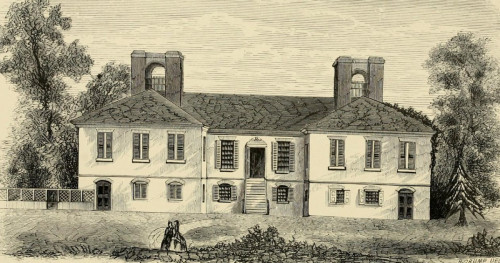
Oppression in the Kitchen, Delight in the Dining Room
The story of Caesar, an enslaved chef and chocolatier in colonial Virginia.
www.bunkhistory.org
Then ask yourself this important question:
Why does it matter how we remember and tell the stories of enslaved cooks and innovators like Caesar?
Select the “View Connections” button to explore more excerpts as connected in Bunk. You may choose different icons as you explore. Note the associated tags that connect each excerpt to another. Explore one or more tags.
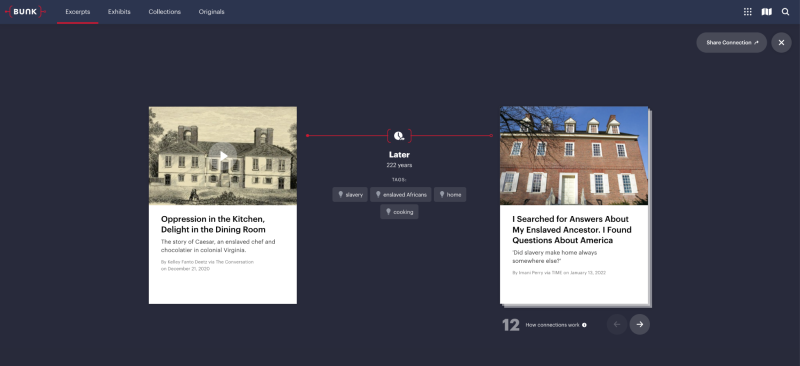
Consider the Following Questions:
- What skills and expertise did Caesar possess, and how were they used or valued by others?
- How is Caesar remembered today, and what evidence helps historians reconstruct his story?
- What similarities do you notice between Caesar’s story and the experiences of enslaved cooks at Monticello?
- What questions do you still have about enslaved culinary workers, and how might historians try to answer them?
Explore a few more of the Bunk connections. Use the sentence frames below to help guide your thinking.
Sentence Frames:
- Caesar’s skills as a cook and chocolatier show that enslaved people possessed ____________, even though their labor was ____________.
- Historians remember Caesar today by using evidence such as ____________, which helps reveal ____________ about his life.
- Caesar’s story connects to the enslaved cooks at Monticello because both ____________, while their contributions were ____________.
- One question I still have about enslaved culinary workers is ____________, and historians might answer it by ____________.
To extend our understanding even further, you will read a BBC article that reveals how the skill, creativity, and knowledge of enslaved cooks influenced American cuisine far beyond Monticello and Caesar – raising new questions about legacy, credit, and remembrance: “The Enslaved Man Who Popularized Mac and Cheese.”
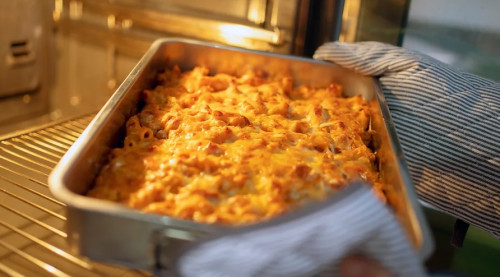
The Enslaved Man Who Popularized Mac and Cheese
The baked dish is one of the US's most popular foods, but its rise can likely be traced back to an enslaved Black chef who worked for Thomas Jefferson.
www.bbc.com
Consider the following:
How does the BBC article add to, extend, or complicate what we learned from Caesar’s story and the kitchens at Monticello?
- This article confirms what I learned about enslaved culinary labor because __________.
- This article expands my understanding by showing __________.
- This article challenges my thinking because I used to believe __________, but now I see __________.
Small-Group Activity: Memory Map — Expanding the Story
1. Create a Memory Map
After reading the Bunk excerpt, exploring at least one connected tag, and reading the BBC article, create a Memory Map on paper or a digital slide.
You can draw small sketches, make bullet points, or create a simple diagram—whatever helps you think visually. This graphic organizer may help you create your Memory Map. Your teacher may also allow you to make a more elaborate digital StoryMap as time permits.
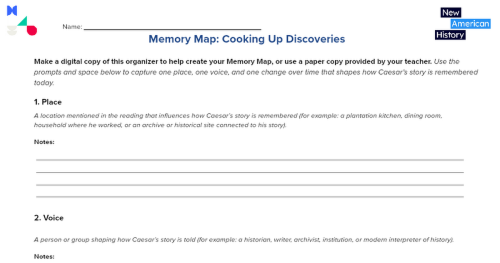
NAH - Cooking Up Discoveries Memory Map
Make a digital copy of this organizer to help create your Memory Map, or use a paper copy provided by your teacher. Use the prompts and space below to capture one place, one voice, and one change over time that shapes how Caesar’s story is remembered today.
docs.google.com
Your Memory Map should include:
- One person or place from the reading that shapes how Caesar’s story is remembered
- One voice that influences how this history is told (historian, institution, writer, descendant, etc.)
- One connection between Caesar’s story and what you learned about Monticello’s kitchens
- One change or challenge to how you previously understood enslaved labor or innovation
You may use sketches, arrows, keywords, or short phrases—whatever helps you think visually. Your teacher may provide a template or allow you to create a more detailed digital StoryMap.
2. Think Pair Share: Making Meaning
Share your Memory Map with a partner. Together, discuss:
- Why does it matter how stories like Caesar’s—and the stories of enslaved cooks at Monticello—are remembered today?
Use specific details from the article, your Bunk connections, or earlier lessons to support your thinking.
3. Whole-Class Share-Out: Connecting the Past to the Present
Be prepared to share one of the following in a class discussion:
- One insight about how enslaved cooks’ expertise shaped early American culture
- One surprise about how Caesar’s story connects to Monticello or challenges common narratives
- One reason why recognizing enslaved culinary labor changes how we think about American history
Closing Reflection – In one or two sentences, respond:
After exploring these stories, how has your understanding grown about the enslaved people whose labor and creativity shaped American food and culinary innovation?
Your teacher may ask you to record your answers on an exit ticket.
Citations:
ArcGIS for Virtual Learners. ESRI. Accessed December 13, 2025. https://storymaps.arcgis.com/stories/1c7cd40aa1b940a4b7ded4acfb09ba4c
Brown, Lynn, “The Enslaved Man Who Popularized Mac and Cheese,” BBC Travel. Accessed December 30, 2025, https://www.bbc.com/travel/article/20251126-the-hidden-history-of-a-classic-american-dish
Facing History & Ourselves. “See, Think, Wonder.” Last modified July 28, 2020. Accessed January 25, 2026. https://www.facinghistory.org/resource-library/see-think-wonder
Facing History & Ourselves.“S-I-T: Surprising, Interesting, Troubling.” Accessed June 17, 2024. https://www.facinghistory.org/resource-library/s-i-t-surprising-interesting-troubling
Facing History & Ourselves. “What is the Give One, Get One Strategy?” February 20, 2015. Accessed March 23, 2025. https://www.facinghistory.org/resource-library/give-one-get-one
Fanto Deetz, Kelley, “Oppression in the Kitchen, Delight in the Dining Room: The Story of Caesar, an Enslaved Chef and Chocolatier in Colonial Virginia,” December 21, 2020. https://www.bunkhistory.org/resources/oppression-in-the-kitchen-delight-in-the-dining-room-the-story-of-caesar-an-enslaved-chef-and-chocolatier-in-colonial-virginia
New American History, “Finding Edna Lewis.” Accessed February 16, 2026. https://resources.newamericanhistory.org/finding-edna-lewis
Keller, Keeley, “10 Reasons You Should Use Sentence Frames In Your Classroom.” September 9, 2022. Accessed March 23, 2025. https://www.teachingchannel.com/k12-hub/blog/10-reasons-you-should-use-sentence-frames-in-your-classroom/#:~:text=1)
Kolumn Magazine. “James Hemings: Paris-Trained, Virginia-Owned.” Accessed February 16, 2026. https://www.kolumnmagazine.com/2026/02/10/james-heming-paris-trained-virginia-owned/
Politzer, Ben, "Reciprocal Teaching," Last modified April 25, 2019. Accessed June 8, 2025. https://www.readingrockets.org/strategies/reciprocal_teaching.
Reading Rockets, “Think-Pair-Share.” Accessed December 30, 2025. https://www.readingrockets.org/classroom/classroom-strategies/think-pair-share
The Teacher Toolkit, “Exit Ticket.” Accessed March 23, 2025. https://www.theteachertoolkit.com/index.php/tool/exit-ticket
Thomas Jefferson’s Monticello, “1809 Kitchen,” Thomas Jefferson Encyclopedia, accessed December 13, 2025. https://www.monticello.org/research-education/thomas-jefferson-encyclopedia/1809-kitchen/
Thomas Jefferson’s Monticello, “Enlighten the People: Fueling Discoveries.” Accessed July 17, 2026. https://monticello.quartexcollections.com/exhibits/icjs30/enlighten-exhibit?page=5
View this Learning Resource as a Google Doc