

This work by New American History is licensed under a Attribution-NonCommercial-ShareAlike 4.0 (CC BY-NC-SA 4.0) International License. Permissions beyond the scope of this license may be available at newamericanhistory.org.
Dispossession, Settlement, and the Homestead Act of 1862
View Student Version
Standards
Common Core:CCSS.ELA-Literacy.RH.6-8.1-10 CCSS.ELA-Literacy.RH.9-10.1-10
C3 Framework:D2.His.3.9-12. Use questions generated about individuals and groups to assess how the significance of their actions changes over time and is shaped by the historical context.D2.Civ5.9-12. Evaluate citizens’ and institutions’ effectiveness in addressing social and political problems at the local, state, tribal, national, and/or international level.D2.Civ.12.9-12. Analyze how people use and challenge local, state, national, and international laws to address a variety of public issues. D2.Civ.13.9-12. Evaluate public policies in terms of intended and unintended outcomes and related consequences.
National Council for Social Studies:People, Places, and EnvironmentsPower, Authority, and Governance
National Geography Standards: Standard 1 - How to use maps and other geographic representations, tools, and technologies to acquire, process, and report information from a spatial perspective
College Board AP U.S. History 6.1: Technological advances, large-scale production methods, and the opening of new markets encouraged the rise of industrial capitalism in the United States.6.2: The migrations that accompanied industrialization transformed both urban and rural areas of the United States and caused dramatic social and cultural change.6.3: The Gilded Age produced new cultural and intellectual movements, public reform efforts, and political debates over economic and social policies.
EAD Roadmap Connections: Theme: We the People Cultivate understanding of personal values, principles, commitments, and community responsibilities. Explore the challenges and opportunities of pluralism, diversity, and unity within the U.S. and abroad. Analyze the impact of enslavement, Indigenous removal, immigration, and other hard histories on definitions of and pathways to citizenship. Evaluate the extent to which marginalized groups have won incorporation into “the people” and advanced the shared values and principles of the U.S.
C3 Framework:D2.His.3.9-12. Use questions generated about individuals and groups to assess how the significance of their actions changes over time and is shaped by the historical context.D2.Civ5.9-12. Evaluate citizens’ and institutions’ effectiveness in addressing social and political problems at the local, state, tribal, national, and/or international level.D2.Civ.12.9-12. Analyze how people use and challenge local, state, national, and international laws to address a variety of public issues. D2.Civ.13.9-12. Evaluate public policies in terms of intended and unintended outcomes and related consequences.
National Council for Social Studies:People, Places, and EnvironmentsPower, Authority, and Governance
National Geography Standards: Standard 1 - How to use maps and other geographic representations, tools, and technologies to acquire, process, and report information from a spatial perspective
College Board AP U.S. History 6.1: Technological advances, large-scale production methods, and the opening of new markets encouraged the rise of industrial capitalism in the United States.6.2: The migrations that accompanied industrialization transformed both urban and rural areas of the United States and caused dramatic social and cultural change.6.3: The Gilded Age produced new cultural and intellectual movements, public reform efforts, and political debates over economic and social policies.
EAD Roadmap Connections: Theme: We the People Cultivate understanding of personal values, principles, commitments, and community responsibilities. Explore the challenges and opportunities of pluralism, diversity, and unity within the U.S. and abroad. Analyze the impact of enslavement, Indigenous removal, immigration, and other hard histories on definitions of and pathways to citizenship. Evaluate the extent to which marginalized groups have won incorporation into “the people” and advanced the shared values and principles of the U.S.
Teacher Tip: Think about what students should be able to KNOW, UNDERSTAND and DO at the conclusion of this learning experience. A brief exit pass or other formative assessment may be used to assess student understandings. Setting specific learning targets for the appropriate grade level and content area will increase student success.
Suggested Grade Levels: High School (9-12), especially A.P. U.S. History course
Suggested Timeframe: Two 90-minute classes, or four 45-minute sessions
Suggested Materials: Internet access via laptop, tablet or mobile device
Key Vocabulary
Antebellum - the time period before a particular war (from the Latin ante ‘before’ and bellum ‘war’), often used to refer to the time before the American Civil War
Affidavit - a sworn written statement for use as legal evidence
Claimant - the person making a legal claim, in this case, a land claim
Class Antagonism - the hostility or opposition between different social classes (i.e., workers and bosses)
Commuting Homesteads - the early purchase of land parcels by claimants before the expiry of the law's standard five-year residency requirement
Digital Humanities - an academic field applying computational tools and methods to learn traditional humanities disciplines such as literature, history, and philosophy
Frontier - the outer, often expanding, limits of a country’s borders, used particularly to describe the expanding western edge of the expansion of the United States across the North American continent
General Land Office - a United States government agency that existed between 1812 and 1946, which was in charge of the nation’s public lands
Historiography - a study of the methods historians use to create historical narratives
Homestead Act - a law passed in 1862 that allowed citizens of the United States to purchase small pieces of land from the Federal Government under the condition that the purchaser live on and/or improve the land for at least five years
Homesteading - the settlement and cultivation of land, often with the goal of establishing ownership
Land Acquisition - the procurement of land, either through purchase, treaty, coercion, or violence
Land Claim - an assertion of ownership rights over a piece of land
Land Dispossession - the forced removal or loss of land ownership, or the expulsion of people from the land on which they live
Nitty Gritty - the most important aspects or practical details of a subject or situation
Patent (for inventions) - a government authority or license conferring a right or title for a set period, especially the sole right to exclude others from making, using, or selling an invention
Patent (for land) - a legal document that officially grants ownership of a piece of public land to a settler who has fulfilled the requirements of the act
Preemption Claim - a legal land claim that allowed a claimant to purchase land for a fixed price before the land went on the market
Postbellum - the time period after a particular war (from the Latin post ‘after' and bellum ‘war’), especially used to refer to the time after the American Civil War
Public Land - land that is owned or managed by the government for public use or conservation
Read for Understanding
Teacher Tips:
New American History Learning Resources may be adapted to a variety of educational settings, including remote learning environments, face-to-face instruction, and blended learning. They follow a variation of the 5Es instructional model, and each section may be taught as a separate learning experience or as part of a sequence of learning experiences. We provide each of our Learning Resources in multiple formats, including web-based and as an editable Google Doc for educators to teach and adapt selected learning experiences as they best suit the needs of your students and local curriculum. You may also wish to embed or remix them into a playlist for students working remotely or independently.
If you are teaching remotely, consider using videoconferencing to provide opportunities for students to work in partners or small groups. Digital tools such as Google Docs or Google Slides may also be used for collaboration. Rewordify helps make a complex text more accessible for those reading at a lower Lexile level while still providing a greater depth of knowledge.
This Learning Resource utilizes a digital map about the Homestead Act produced by Julius Wilm, Robert K. Nelson, and Justin Madron for American Panorama, a project of the University of Richmond’s Digital Scholarship Lab.
This Learning Resource includes excerpted articles from Bunk, a shared home for the web's most interesting thinking about American history. Students and teachers can view the excerpts in Bunk, or, by selecting the “View on…” button at the bottom of the page, view the full version where it was originally published.
This Learning Resource includes materials in the public domain from the National Archives and videos from Untold History, for primary source analysis. Graphic organizers are shared to help students record and organize their thoughts.
The “Engage,” “Explain,” “Elaborate,” and “Extend” sections of this Learning Resource are designed so that students will work in pairs and/or small groups.
This Learning Resource contains sensitive historical facts and terms, including a discussion of slavery. Some students may be triggered emotionally by the content; when available, follow your district’s Social Emotional Learning (SEL) guidelines. Also, be aware of a student’s ability to process the information independently. This link from The Cult of Pedagogy offers ideas for teaching through a lens of historically responsive literacy. Throughout the lesson, teach with resilience, incorporate self-awareness, connect relationships to today, and consider accountability.
Read for Understanding (for students)
Signed into law by Abraham Lincoln on May 20th, 1862, just over a year into the Civil War, the Homestead Act allowed American citizens to purchase, for a small fee, plots of farmland in the western United States. The act, which required tenants to improve the land through cultivation, played into long-held sentiments of America as a nation of yeomen farmers—an idea Thomas Jefferson embraced in the early years of the republic. As an act that encouraged settlement across the continent, it was also crucial in the displacement of Native Americans from their ancestral lands.
Engage:
What was the Homestead Act of 1862?
In this Learning Resource, you will examine the text of the Homestead Act through both primary sources and maps, and then consider its effects across American society at the time.
Read the original text of the Homestead Act of 1862. A first read of the primary source will give you an overview of its intent and contents before considering the political and economic implications of the law.
Use this graphic organizer to read a transcribed version of the Homestead Act. Read the text in pairs or small groups, as directed by your teacher.
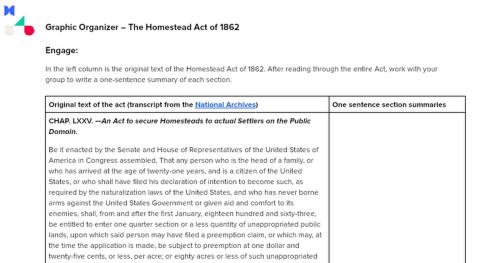
NAH Homestead Act Graphic Organizer Pt. 1
Engage: In the left column is the original text of the Homestead Act of 1862. After reading through the entire Act, work with your group to write a one-sentence summary of each section. Original text of the act (transcript from the National Archives) One sentence section summaries CHAP. L...
docs.google.com
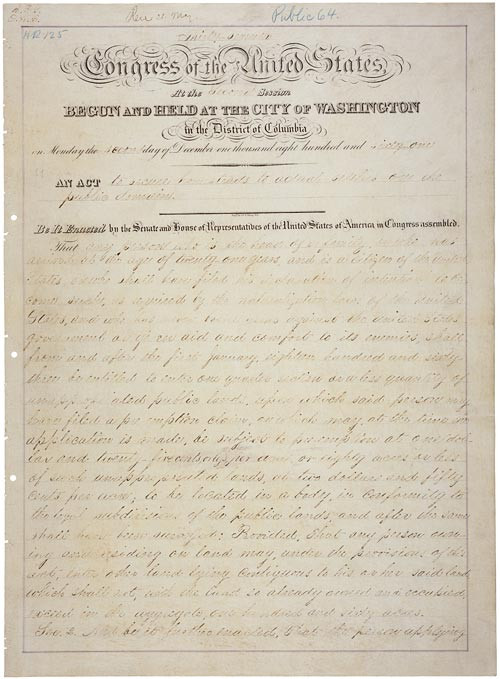
Homestead Act (1862)
Passed on May 20, 1862, the Homestead Act accelerated the settlement of the western territory by granting adult heads of families 160 acres of surveyed public land for a minimal filing fee and five years of continuous residence on that land.
www.archives.gov
In the left column, you will find the text of the Act. As you read each of the eight sections of the Act use the right column to summarize each section in your own words as best as you can. Try to limit your summary of each section to one simple, concise sentence. If there are parts you don’t understand, don’t worry! You are simply trying to get an overall sense of what this law is about. Share your responses with your partner or small group, as directed by your teacher.
After you have finished, discuss the following questions with your partner or group:
- What do you think is meant by “public land”?
- Who does the act authorize to make a land claim? Who is excluded?
- How much does this land cost?
- What do you think are the goals of the Act?
Now that you have a sense of the Act itself, read the Introduction to “Land Acquisition and Dispossession: Mapping the Homestead Act, 1863-1912” to learn more about the historical context of the Act and why mapping it is useful. This Introduction is part of a digital humanities mapping project by Julius Wilm, Robert K. Nelson, and Justin Madron for American Panorama.
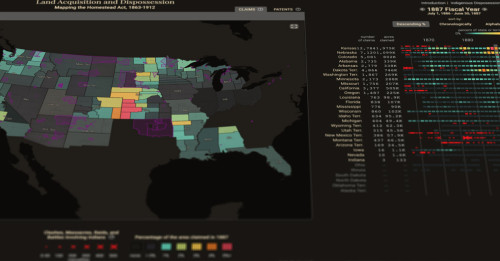
Land Acquisition and Dispossession: Mapping the Homestead Act, 1863-1912
Year-by-year maps of homesteading claims and patents in the American West and South and the dispossession of Native American lands.
dsl.richmond.edu
After you have finished, discuss the following questions with your group:
- What is homesteading, and why was it controversial?
- What existing American values did the Homestead Act emerge from?
- Why is mapping the Homestead Act useful?
- Did the Introduction clarify anything that you did not understand when you first read the text of the act? Note this on your graphic organizer.
Your teacher may ask you to record your answers on an exit ticket.
Explore:
How did the Homestead Act enable settlement in the American West?
Explore the Map
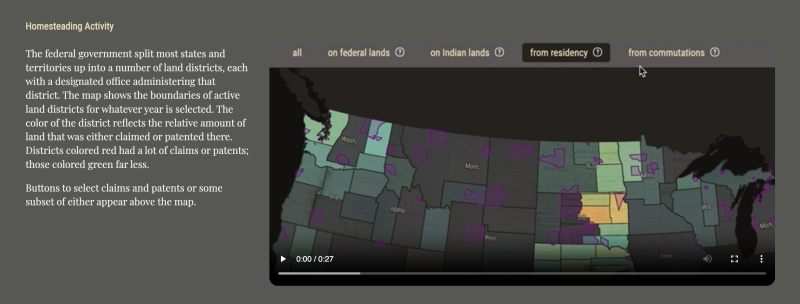
Take a few minutes to explore Land Acquisition and Dispossession Mapping the Homestead Act, 1863-1912, which visualizes the history of the Homestead Act throughout its first 50 years. Navigate to the map using the orange “Explore the Map” button located in the header of the homepage. The map shows the boundaries of active land districts from 1863-1912. The color of the district reflects the relative amount of land that was either claimed or patented there. Districts colored red had a lot of claims or patents; those colored green had far fewer. Buttons to select claims and patents, or some subset of either, appear above the map.
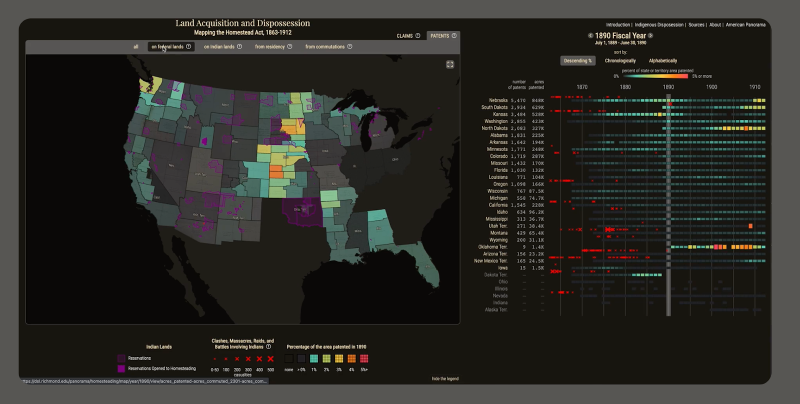
Navigating the map:
Scroll down to view “Homesteading Activity,” the first instructional video on how to use the map.
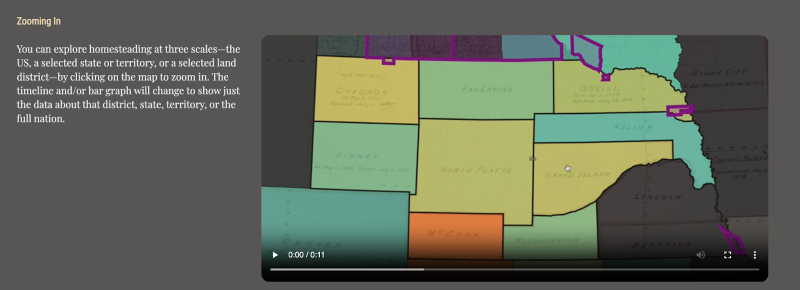
Next, scroll down to view the second video, “Zooming In”.
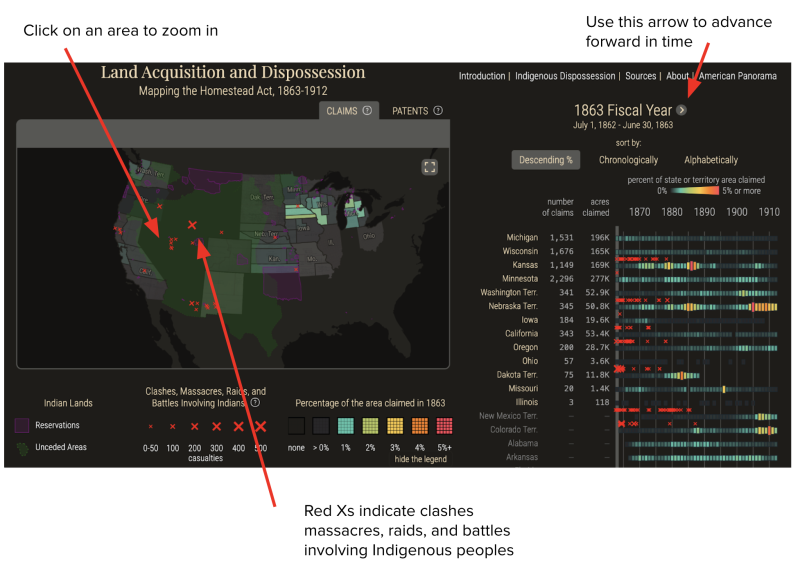
This video illustrates how you can explore homesteading at three scales—the US, a selected state or territory, or a selected land district—by clicking on the map to zoom in. The timeline and/or bar graph will change to show just the data about that district, state, territory, or the full nation. Return to the map and further explore using these different scales.
The third video, “Change Over Time,” illustrates that as the entire US or a state or territory is selected, a timeline shows changes in homesteading activity between 1863 and 1912. You can jump to any year by selecting it on the timeline.
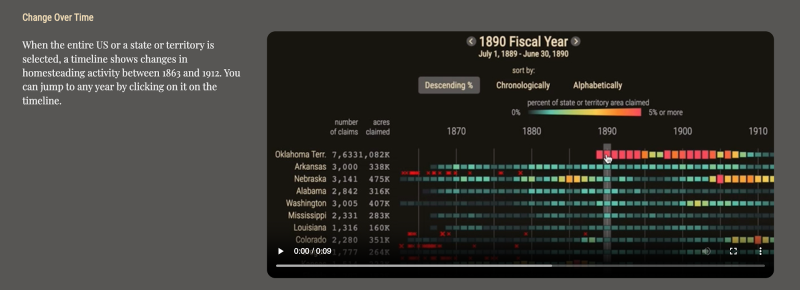
When a state, territory, or district is selected, a couple of bar graphs let you see details about claims and patents over time. It's clickable too, to change the year that's mapped.
The final video, “The Nitty Gritty,” digs deeper into more specific data. Take time to further explore the map as time permits.
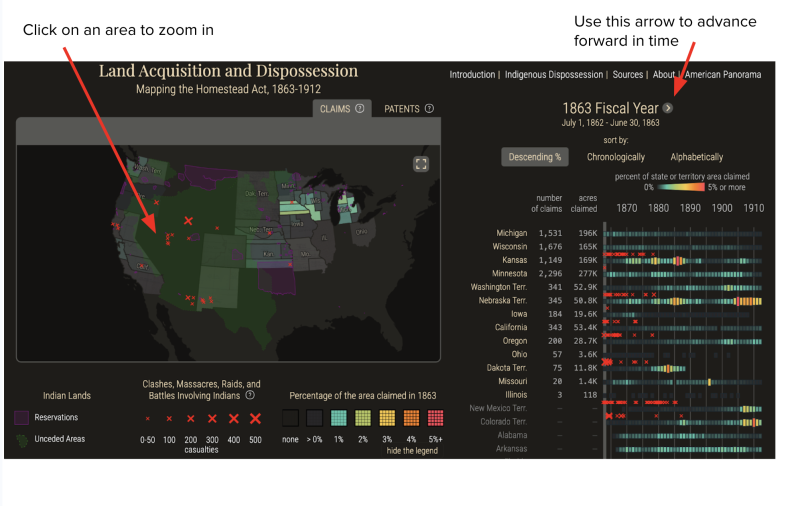
After spending a moment clicking around to familiarize yourself with the interface, use the right-facing arrow next to “1863 Fiscal Year” to advance forward in time.
As you move toward 1912 by selecting the right-facing arrow, think about the following questions:
- What is the difference between “claims” and “patents”? (Hint: on the main map page, select the question mark icon next to each of these terms.)
- How does the map change over time? What does the map allow us to learn about the process of settlement throughout the American West? What story do these changes tell about the effects of the Homestead Act?
- What are you curious about that is not captured on the map?
- Is there anything else that captures your eye?
After you have spent some time with the map by yourself, Turn and Talk to a partner and discuss the above questions.
Your teacher may ask you to record your answers on an exit ticket.
Explain:
How did the Homestead Act enable land dispossession?
Begin by reading the “Homesteading and Indigenous Dispossession” section from “Land Acquisition and Dispossession: Mapping the Homestead Act, 1863-1912,” in American Panorama.
- In the view of the authors, how does their map document the links between homesteading and the dispossession of Indigenous land?
- What are “homesteads on Indian land”?
- Describe the differences between how the Homestead Act worked in theory (i.e., ‘by the letter of the law’) versus in practice. What do these differences highlight about the process of American territorial expansion and settlement?
- Think back to your discussion from the Engage section on the meaning of “public land.” Has your understanding of “public land” changed?
Now, return to the map.
You will repeat the same exercise as you did in the Explore section—advancing through time from 1863 to 1912 using the arrows—but this time pay particular attention to the relationship between clashes, massacres, raids, and battles involving Indians (red Xs) and the extents of unceded Indian lands (shaded green) and reservations (shaded purple). First, explore this relationship at the scale of the whole country. Then zoom in to the individual states, territories, and district land offices for more detail (to zoom in, click on the area of the map you want to zoom to).
Finally, discuss with your partner:
- How did the map allow you to see new patterns regarding land settlement and dispossession? Did anything surprise you?
- What kinds of information does the map not convey?
Your teacher may ask you to record your answers on an exit ticket.
Elaborate:
How did the Homestead Act affect African Americans and Indigenous peoples?
While the passage of the Homestead Act coincided with Abraham Lincoln’s 1863 Emancipation Proclamation, many factors made it difficult or impossible for Black people to establish homesteads. Slavery itself remained legal until the 13th Amendment was ratified in 1865, and formerly enslaved Black people remained ineligible to obtain land through the Homestead Act until the 14th Amendment granted them citizenship in 1868. On top of this, formerly enslaved people rarely had the resources to acquire and improve the land as stipulated by the Homestead Act.
For an overview of how slavery remained even after the Emancipation Proclamation, watch this short video from Untold History.
Despite the shortcomings of the Emancipation Proclamation and the challenges posed by the requirements of the Homestead Act, some formerly enslaved Black people moved out of the South and settled on Native American lands in the West in the final decades of the 19th century. You just examined how the Homestead Act enabled the dispossession of Native American lands. Now, before beginning this section, consider the following pre-reading question:
What do you expect to be the relationship between formerly enslaved Black people moving west and Native Americans?
Next, read excerpts from two articles in this Bunk collection. The first, “Is This Land Made for You and Me?,” by Alaina E. Roberts, published in Lapham’s Quarterly, examines the relationships between African Americans and American Indians throughout the nineteenth century (a full version is available in Lapham’s Quarterly). The second, “The disappearing story of the black homesteaders who pioneered the West,” is an excerpt of an op-ed in the Washington Post by Richard Edwards. goes into more depth about specific Black homesteads (a full version is available from the Washington Post).
Then, watch this video from Untold History about Letitia Carson, the only Black woman in Oregon to successfully receive land through the Homestead Act.
After you read and watch, turn to a partner and discuss the following:
- How did the Homestead Act, the westward movement, and the settlement of formerly enslaved people more generally affect the dynamics between African Americans and Native Americans in the postbellum period?
- What were the legal and economic factors that prevented formerly enslaved Black people from establishing homesteads?
- How did slavery and other forms of racial violence, both before and after the Civil War, shape Black views of property and settlement? Select two historical figures referenced in the article whose statements illustrate your claim.
- Finally, think back to what you thought would be the relationship between formerly enslaved Black people moving west and Native Americans before you read Roberts’s piece. Did the piece subvert your expectations about relations between formerly enslaved Black people and Native Americans?
Your teacher may ask you to record your answers on an exit ticket.
Extend:
What is a frontier?
In this final section, you will take a brief dive into the historiography of American territorial expansion. You will consider the idea of the “frontier” in the context of American history and propose your own way of thinking about American territorial expansion.
First, read an excerpt in Bunk of the article “Reconsidering Expansion” by Rachel St. John, published by the Organization of American Historians (a full version is available on the OAH website).
After you have finished reading, discuss the following questions with an elbow partner:
- What problems with the term “expansion” does St. John identify?
- When is this term useful? What does it obscure?
- How does St. John’s essay inform or change your understanding of the Homestead Act?
- Do you agree with St. John’s claims?
- Next, you are going to use Bunk’s tagging feature to find another source that discusses the idea of the frontier. In Bunk, select the “View Connections” button.
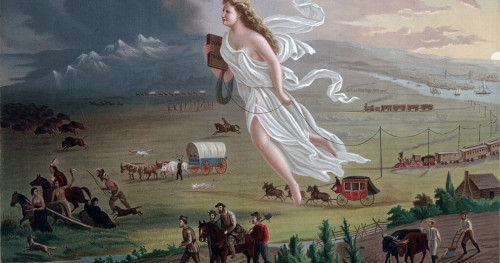
Reconsidering Expansion
Historians question "expansion" as the defining process of U.S. growth, proposing alternative terms like "empire" and "settler colonialism."
www.bunkhistory.org
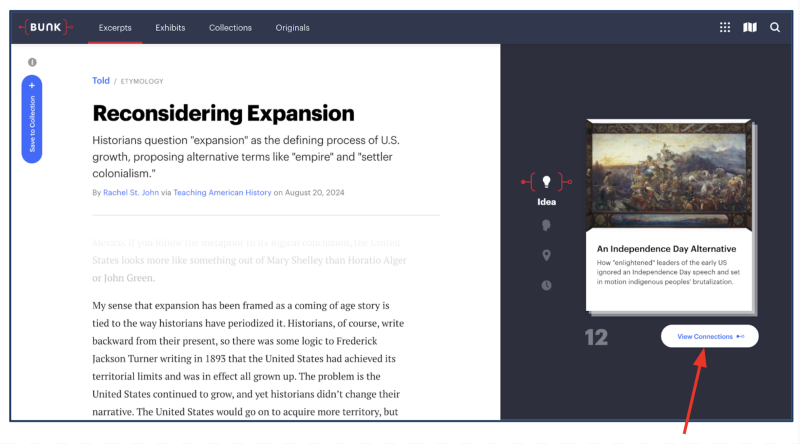
Then select the “frontier” tag.
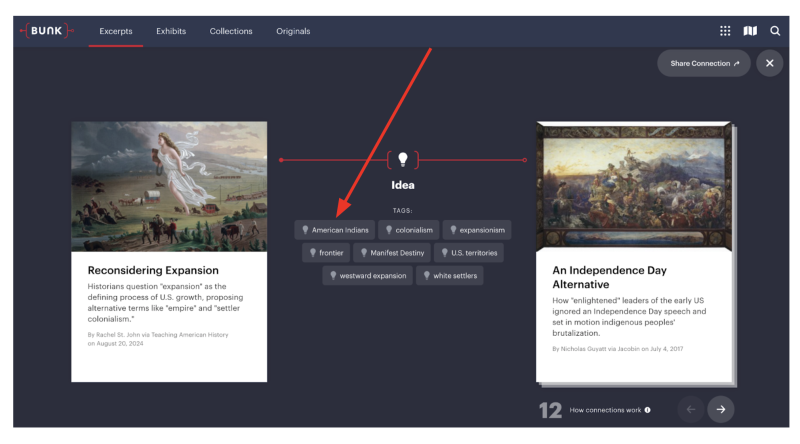
Take some time to scroll through the articles that are listed under that tag. Pick one that you think will help you develop an understanding of the larger historical patterns that defined and continue to define the growth of America. The article you pick does not necessarily have to be about the Homestead Act—though it can be—nor does it have to be about expansion in the postbellum period. It should, however, relate to the ideas that you have explored throughout this learning resource, such as the frontier, land dispossession, and colonialism.
After you have chosen an article, you will write a two-paragraph response to the question: “What is a frontier?” Your first paragraph should discuss what the Homestead Act teaches us about the idea of the frontier in American history. Your second paragraph should discuss how the article you chose either supports or complicates that idea.
Your teacher may ask you to record your answers on an exit ticket.
Citations:
Edwards, Richard. “The disappearing story of the black homesteaders who pioneered the West.” Washington Post (Washington, D.C.), July 5, 2018.
“Homestead Act (1862).” National Archives. Reviewed June 7, 2022. https://www.archives.gov/milestone-documents/homestead-act
Robert, Alaina E. “Is This Land Made for You and Me?” Lapham’s Quarterly, May 26, 2021. https://www.laphamsquarterly.org/roundtable/land-made-you-and-me
St. John, Rachel. “Reconsidering Expansion.” The American Historian (Organization of American Historians), August 20, 2024. https://www.oah.org/tah/expansion/reconsidering-expansion/
Wilm, Julius, Robert K. Nelson, and Justin Madron. “Homesteading.” American Panorama. Edited by Robert K. Nelson and Edward L. Ayers. Accessed February 26, 2025. https://dsl.richmond.edu/panorama/homesteading/
View this Learning Resource as a Google Doc