

This work by New American History is licensed under a Attribution-NonCommercial-ShareAlike 4.0 (CC BY-NC-SA 4.0) International License. Permissions beyond the scope of this license may be available at newamericanhistory.org.
The Enslaved Community: Sally Hemings
Key Vocabulary
Archaeological evidence - Physical artifacts, structures, features, or remains uncovered by archaeologists that provide clues about past lives and practices. For example, stew stoves discovered at Monticello help illuminate daily life in the enslaved community.
Concubine - Historically, a woman in a long-term physical relationship with a man to whom she is not married and who often has a lower social status. Madison Hemings used this word to describe his mother's relationship with Thomas Jefferson. The exact nature of that relationship is unknown. Historians, scholars, and even descendants of Hemings and Jefferson disagree about how they may have felt about one another. There was always an imbalance of power between an enslaved person and the person who enslaved them.
Descendants - The later generations descended from a forebear – in this case, the children and further generations of the Hemings family. Monticello’s Getting Word African American History Department preserves many of these voices and family histories.
Documentary evidence - Records, such as written correspondence and newspaper accounts, that historians use to reconstruct the past. Historians also use other sources, including oral histories and material culture, to arrive at interpretations and conclusions.
Enslaved / Enslavement - The condition of being legally owned by another person and forced to labor without freedom. The term “enslaved” is used instead of “slave” to emphasize that enslavement was a condition that said person experienced, rather than defining them solely by their condition.
Estate - an extensive area of land in the country, usually with a large house, owned by one person, family, or organization.
Forebear - an ancestor such as a grandparent or great-grandparent.
Interpretation / Re-interpretation - How historians, museums, and societies make sense of historical evidence and narratives, and how those can change when new evidence or perspectives emerge. For example, Monticello’s reinterpretation of Hemings’s story.
Legacy - The long-term effects or consequences of historical events, people, or institutions—in this case, how the story of Sally Hemings affects the way we understand America’s founding and slavery as part of human history.
Material culture - The physical objects people create and use in daily life (ex.: artifacts, clothing, food, buildings, documents, tools, and technology - such as a thimble used for sewing).
Mind Map - A visual representation of a concept or process. Mind mapping can be used for many academic tasks, including note-taking, writing a paper, brainstorming, and studying for exams.
Oral history - The recording and use of spoken memories and stories from people who experienced historical events (or their descendants). For example, the Hemings family oral histories played a key role in reshaping understanding at Monticello.
Racial Passing - The phenomenon of individuals of mixed ancestry presenting or being accepted as a different racial group (often white) to escape discrimination or gain social advantages. In the Hemings's children's story, some family members utilized passing as a way to navigate the world they lived in.
Plantation - A large agricultural estate (especially in the American South) where cash crops were grown, most often using enslaved labor.
Plantation economy - An economic system based on large-scale agricultural production of cash crops (such as cotton, tobacco, sugar, and coffee) for export, rather than local consumption; Monticello functioned within such an economy.
Read for Understanding
From 1770 until 1826, Thomas Jefferson — author of the Declaration of Independence and third president of the United States — lived at his mountain estate and plantation, Monticello, in Virginia. But Monticello was also home to hundreds of people who were enslaved, including Sally Hemings, a woman of mixed race whom Jefferson held in slavery. Hemings's story reveals how freedom and slavery existed side by side in the early American republic, and how power, family, and identity were deeply intertwined. For many years, her life was left out of traditional histories, but ongoing research—including documentary evidence, oral histories, DNA evidence, and archaeology—has helped historians tell a fuller, more honest story. As we study Sally Hemings and Monticello, we’ll explore what her story teaches us about America’s founding ideals and the people whose lives shaped them.
Engage:
Why is it important to tell Sally Hemings's story at Monticello?
Monticello was the home of Thomas Jefferson, the author of the Declaration of Independence and the third president of the United States. But Monticello was also home to over 400 people who were enslaved — including Sally Hemings, a woman whose life and story challenge us to look more deeply at America’s founding ideals. For years, many historians ignored her story. For decades, Monticello has sought to tell an honest and comprehensive story about all of those who lived and labored at Monticello, including Sally Hemings. As we begin, let’s think about this question: Why is it important to tell Sally Hemings’s story at Monticello?
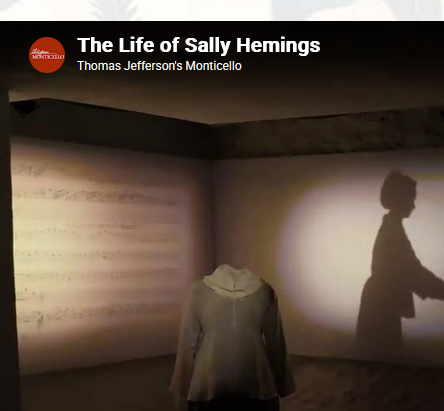
The Life of Sally Hemings
An in-depth look at Sally Hemings, who was enslaved by Thomas Jefferson and bore several of his children, using the recollections of her son Madison Hemings.
www.monticello.org
While you explore the exhibit, keep these questions in mind: “What questions do I have?” and “What surprises or new ideas stand out to me?” Be sure to take time to view the digital image gallery and video representation of the exhibit.
Self-Reflection
After viewing the video at the beginning of the digital exhibit website, consider:
- What did you notice about how Monticello is presented, and how the story of Sally Hemings is presented?
- What surprised you or made you think differently about what you already knew (or didn’t know) about Monticello, enslaved people, and American history?
- What questions do you now have after watching this video? (Write 2-3 questions.)
- Why do you think it’s important for us to learn about Sally Hemings when studying the early United States?
Sentence Frames:
- In the digital exhibit, I noticed that Monticello is presented ____________________, while Sally Hemings is presented ____________________.
- I’m surprised by ____________________ because _______________________.
- I wonder __________________________. I would like to know more about ________________________.
- I think it’s important for us to learn about Sally Hemings when studying the early United States because ________________________.
Use the Give One/Get One protocol to exchange ideas with a classmate (or two) and record their answers below using this graphic organizer. You may make a digital copy or use a paper copy provided by your teacher.
NAH Give One, Get One: Sally Hemings
“The Life of Sally Hemings” Make a copy of this graphic organizer to record your responses, or use a paper copy provided by your teacher.
docs.google.com
Your teacher may ask you to record your answers on an exit ticket.
Explore:
What evidence helps us understand Sally Hemings's life and her connection to Thomas Jefferson?
Historians don’t just tell stories about the past — they build those stories from evidence. For many years, the life of Sally Hemings was mentioned only briefly or left out of the narrative by some scholars. In this activity, you’ll look at how scholars at Monticello gathered and analyzed that evidence to better understand Sally Hemings's life and her connection to Thomas Jefferson.
As you read, think back to the digital exhibit you explored about The Life of Sally Hemings. Highlight or note the different types of evidence historians discuss (for example: oral histories, letters, documents, material culture, and DNA testing). Look at how all of these materials fit together.
As you explore these sources, think about our question: How do historians know what they know about Sally Hemings?
Step 1: Read and Observe
Visit or review excerpts - as suggested below, or by your teacher - from “Report of the Research Committee on Thomas Jefferson and Sally Hemings.”

Report of the Research Committee on Thomas Jefferson and Sally Hemings
An overview and list of members of the Thomas Jefferson Foundation's committee looking into the 1998 DNA study linking the Jefferson and Hemings families.
www.monticello.org
- As you read, highlight or note the different types of evidence historians discuss (for example: DNA testing, oral histories, letters, documents).
- You may choose to focus on Part IV. “Research Findings & Implications.”
- Ask yourself: Which pieces of evidence seem strongest or most convincing? Which pieces of evidence raise new questions?
Step 2: Analyze the Records

Appendix H: Sally Hemings and Her Children
An overview and list of members of the Thomas Jefferson Foundation's committee looking into the 1998 DNA study linking the Jefferson and Hemings families.
www.monticello.org
- Use the names, dates, and events to create a brief timeline of Sally Hemings's life and her children’s lives.
- Look for patterns or gaps: What do we know for certain? What is still unclear or missing?
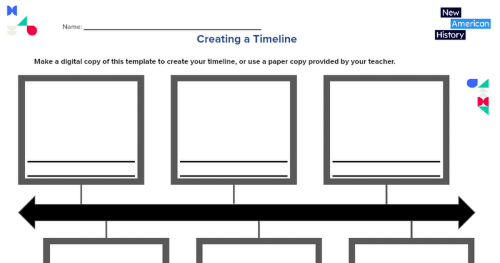
NAH - Timeline Template
Make a digital copy of this template to create your timeline, or use a paper copy provided by your teacher. Name: Creating a Timeline
docs.google.com
Step 3: Reflect and Discuss
With a partner or in your small group, as directed by your teacher, discuss:
- What kinds of evidence help us tell Sally Hemings's story more completely?
- How do these sources change or deepen your understanding of Monticello?
- Why might some evidence have been ignored or dismissed in the past?
Sentence Frames:
- The evidence that helps us tell Sally Hemings's story is ______________.
- These sources change/deepen my understanding of life at Monticello for all people who resided there by ___________.
- I think some evidence might have been ignored or dismissed in the past because _____________.
You may take notes on the information you are most interested in exploring using the S-I-T Strategy. Your teacher may provide a paper copy of the graphic organizer or allow you to make a digital copy.
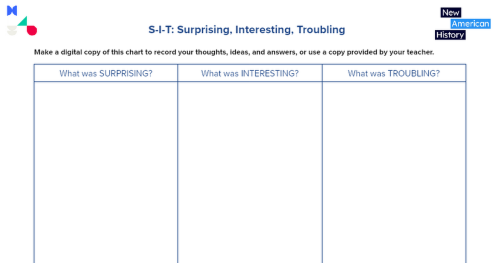
NAH S-I-T: Surprising, Interesting, Troubling
Make a digital copy of this chart to record your thoughts, ideas, and answers, or use a copy provided by your teacher. What was SURPRISING? What was INTERESTING? What was TROUBLING?
docs.google.com
Your teacher may ask you to record your answers on an exit ticket.
Explain:
How do historians use evidence to tell Sally Hemings's story, and what does it reveal about her life at Monticello?
You will use the Reciprocal Teaching Protocol in small groups to discuss your understanding of the information you have analyzed so far. You may use this graphic organizer/roles handout as you discuss this question with your group and take turns asking questions or switching roles.
Reciprocal Teaching is a group reading strategy where everyone takes on a role to help the group better understand a text, image, or short video. Each person within the group has a role:
- Questioner – Asks big or tricky questions about the text to spark discussion.
- Summarizer – Gives a quick recap of the most important ideas.
- Clarifier – Clears up confusing words, phrases, or sections.
- Connector – Makes connections between the text and real life, other readings, or personal experiences.
By working together and rotating roles, everyone builds a deeper understanding—and helps teach each other!
Choose Roles in Small Groups: Each of you will choose one of the following roles:
Questioner – Pose deep, open-ended questions to drive discussion:
- Evidence-Based Question: What specific piece of evidence from this source helps us understand Sally Hemings's life, and why is it important?
- Interpretation Question: How do historians interpret this evidence, and do you think there could be another way to understand it?
- Connection Question: How does the section of the source you explored connect to what we learned about Sally Hemings's family or her relationship to Jefferson?
Summarizer – Briefly identify the main ideas and key points:
- Main Idea: What is the most important idea or piece of information in this source about Sally Hemings?
- Evidence Connection: Which pieces of evidence did we discuss that help explain her life or her story, and what do they show?
- Reflection/Big Picture: Based on this section, what can we now say about how historians reconstruct Sally Hemings's life?
Clarifier – Clear up confusion or difficult language:
- Term/Concept Clarification: What words, phrases, or ideas in the section your teacher invited you to explore are confusing, and how can we figure out what they mean?
- Evidence Understanding: Is there any piece of evidence here that is unclear or hard to interpret? How might we make sense of it?
- Context Check: Does anything in this source need background knowledge or context from the Explore section of this learning resource to fully understand?
Connector – Link ideas from the source to personal experience, other texts, images, or videos, or current events:
- Text-to-Text: How does this evidence or story about Sally Hemings connect to other sources we’ve explored, like Appendix H or the Research Committee Report?
- Text-to-Self: Does anything in this source remind you of something you’ve learned or experienced earlier? How does it help you understand her story?
- Text-to-World: How does what we’re learning about Sally Hemings connect to broader ideas about slavery, American history, or how people’s stories are remembered?
Rotate roles in later rounds so that you may each have the opportunity to try each one.
Whole Class Reflection: After small-group discussions, come together to reflect:
Evidence and Understanding:
- What new insights did we gain about Sally Hemings from the evidence we examined, and how did the different types of evidence help tell her story?
Historical Thinking:
- How do historians decide which sources are trustworthy, and what challenges do they face when reconstructing the lives of people like Sally Hemings?
Broader Significance:
- Why is it important to tell Sally Hemings's story today, and how does understanding her life change the way we think about Monticello and American history?
Sentence Frames:
- From the evidence we’ve examined, I’ve learned that Sally Hemings ______________.
- This evidence helps tell her story by _______________.
- Historians decide which sources are trustworthy by ___________________.
- Some of the challenges they faced in telling Sally Hemings's story were ____________.
- It’s important to tell Sally Hemings's story today because _______________.
- Understanding her life changes the way we think about Monticello and American history because ______________.
Consider this question as a final reflection:
What is one important thing you learned about Sally Hemings and how historians reconstruct her story?
Your teacher may ask you to record your answers on an exit ticket.
Elaborate:
How might understanding Sally Hemings's experiences from different perspectives change the way we think about history as it relates to today?
Now that you’ve explored Sally Hemings's life through the Monticello website, it’s time to deepen your understanding of the different perspectives surrounding Sally Hemings and the enslaved community at Monticello. In this activity, you will explore the voices of people connected to Hemings's story—past and present—and think about how their experiences shape the way we understand history. By considering these viewpoints, you’ll see how history is not just a set of facts, but a collection of human experiences that continue to influence us today.
Getting Word
Getting Word is the African American history department at Monticello, Thomas Jefferson’s plantation home. Founded in 1993, Getting Word records and preserves the family histories of the over 610 people enslaved by Jefferson throughout his lifetime.
gettingword.monticello.org
You will explore Monticello’s Getting Word African American History Department website. First, spend some time reading and listening to excerpts from the Getting Word page for Sally Hemings. Explore the Related People section of the page, primary source images, and other content linking Hemings and her descendants.
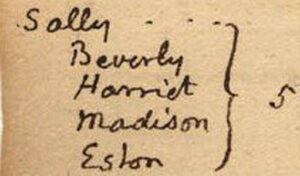
Sally Hemings
Sally Hemings was born in 1773 at The Forest, the plantation home of her enslaver and father, John Wayles. Her mother was Elizabeth Hemings, an enslaved, mixed-race woman who was also owned by John Wayles (the father of Martha Wayles Skelton, Jefferson’s wife). Following John Wayles’ death, the Hemingses (Sally Hemings, her mother, and her siblings) were brought... Read more »
gettingword.monticello.org
On the Sally Hemings page, scroll down and find the section labeled "Hear the Voices.”
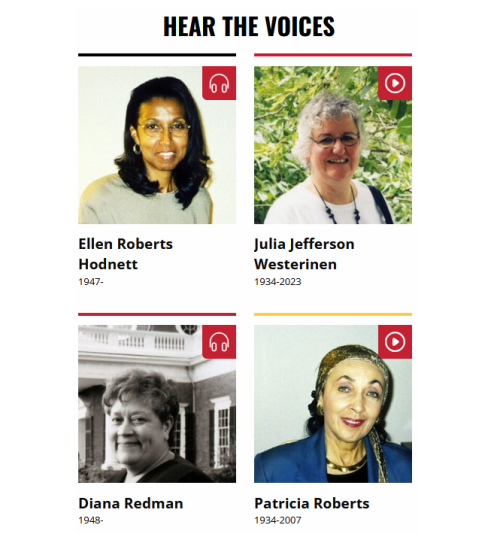
Hear the Voices
Getting Word participants have shared oral histories that showcase the skills, values, and powerful bonds of family that have been passed down over more than seven generations.
gettingword.monticello.org
Find and select the audio clip labeled "Diana Redman" under "Hear the Voices.” Listen to the audio clip from Diana Redman, a member of the descendant community, as she describes the imbalance of power between enslaved women and their owners in the 18th century. Continue exploring 1-2 other descendants’ voices in this section of the page.
Revisit the key ideas you uncovered in “Engage,” “Explore,” and “Explain” about Sally Hemings - her life, her relationships, and her legacy. In pairs or small groups discuss the following perspectives shared in your further reading from the Getting Word African American History Department. Share any new insights you gained from reading about the following people:
- Sally Hemings's mother, Elizabeth Hemings
- A child of Sally Hemings - Madison Hemings or Eston Hemings Jefferson
- A descendant community member (Diana Redman, and 1-2 others from the Hear the Voices section of the Sally Hemings page).
Use the Circle of Viewpoints thinking routine to help unpack your thoughts about the new viewpoints you explored from the Getting Word project.
Choose ONE perspective to explore, using these sentence-starters:
- I am thinking of ... (the topic) ... from the viewpoint of ... (the viewpoint you’ve chosen)
- I think ... (describe the topic from your viewpoint).
- A question I have from this viewpoint is ... (ask a question from this viewpoint)
Your teacher may ask you to record your answers on an exit ticket.
Extend:
Why does it matter how we remember and tell the stories of people like Sally Hemings?
Now that you’ve explored Sally Hemings's life through the lens of the Monticello website, it’s time to think about how her story is remembered from other perspectives today. In this activity, you’ll use Bunk, a helpful tool for building background knowledge from a variety of primary and secondary sources. You’ll reflect on why it matters how history is told, whose voices are included, who is sharing the stories, and how these stories shape our understanding of the past and present.
Read this Bunk excerpt, “Jefferson’s Monticello Finally Gives Sally Hemings Her Place in Presidential History,” and ask yourself this important question:
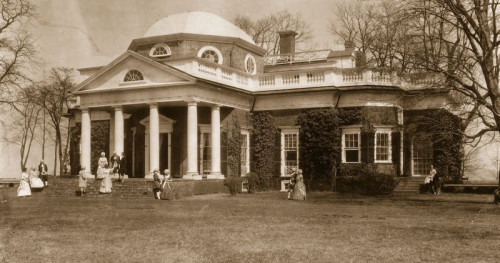
Jefferson’s Monticello Finally Gives Sally Hemings Her Place in Presidential History
New exhibits put slavery at the center of Monticello's story, and make it clear that Jefferson was the father of Hemings' children.
www.bunkhistory.org
Why does it matter how we remember and tell the stories of people like Sally Hemings?
Select the “View Connections” button to explore more excerpts as connected in Bunk. You may choose different icons as you explore. Note the associated tags that connect each excerpt to another. Explore one or more tags.
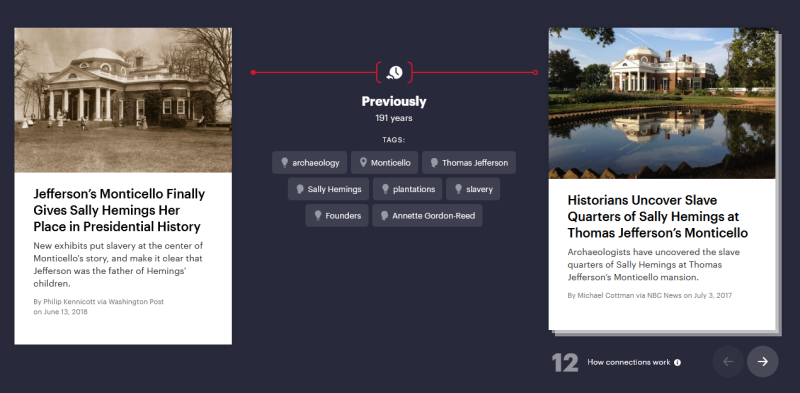
Consider the following questions:
- How do the interpretations about Sally Hemings you viewed in Bunk compare to the sources you explored on the Monticello and Getting Word websites?
- What similarities and differences did you find between these sources?
- Why does it matter that Monticello installed an exhibit about Sally Hemings in a room where she may have lived?
- How has the story of Sally Hemings changed over time?
- What does Sally Hemings's story teach us about slavery beyond agricultural work – particularly as it relates to enslaved women?
- How does learning about the people Jefferson enslaved change the way we think about the author of the Declaration of Independence?
- What questions do you still have about Sally Hemings or Monticello, and how could you find answers?
Explore a few more of the Bunk Connections as time permits.
Small-Group Activity: History in Our Hands - Mind Map
Create a Mind Map
After you read the Bunk excerpt and explore at least one connected tag, make a quick mind map on a blank sheet of paper or a digital slide.
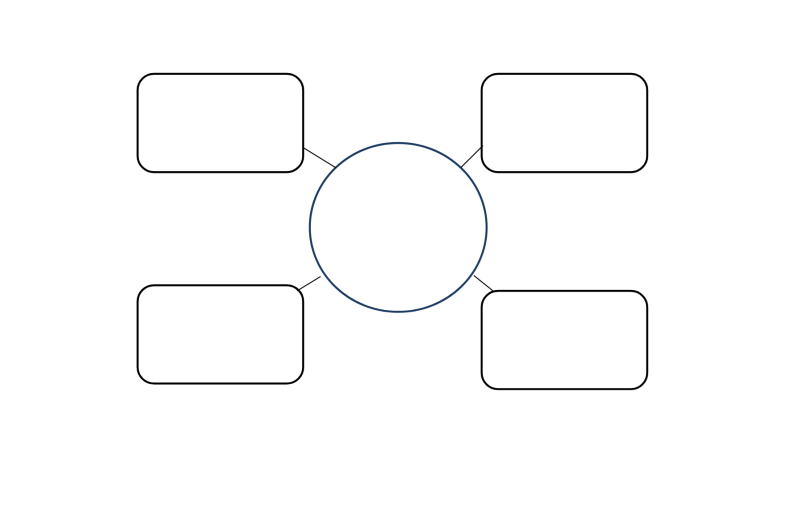
Your map should include:
- One place from the reading that affects how Sally Hemings is remembered today (for example, her restored room at Monticello).
- One voice that influences how her story is told (such as a historian, a descendant, or an institution).
- One change in how people have interpreted her story over time.
You can draw small sketches, make bullet points, or create a simple diagram—whatever helps you think visually. This organizer may help you create your mind map. Your teacher may also allow you to make a more elaborate digital mind map as time permits.
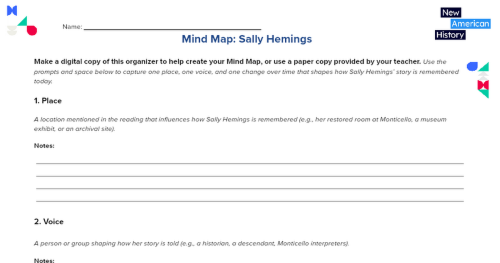
NAH - Sally Hemings Memory Map
Make a digital copy of this organizer to help create your Mind Map, or use a paper copy provided by your teacher. Use the prompts and space below to capture one place, one voice, and one change over time that shapes how Sally Hemings’ story is remembered today.
docs.google.com
Pair Share: Why Does This Matter?
Share your mind map with a partner. Together, answer this question:
Why does it matter how Sally Hemings's story is remembered today?
Use details from the reading or the Connections you explored to support your ideas.
Class Share-Out: One Insight, One Surprise
Be ready to share your thoughts in a whole-class discussion as directed by your teacher:
- One insight about how Sally Hemings's story has been re-framed.
- One surprise about how others' voices helped shape these changes.
This will help us connect back to the big question of why the way we tell history matters.
Your teacher may ask you to record your answers on an exit ticket.
Citations:
Canva. “Free Online Mind Maps.” https://www.canva.com/graphs/mind-maps/ Accessed February 10, 2026.
Facing History and Ourselves. “What is the Give One, Get One Strategy?” February 20, 2015. https://www.facinghistory.org/resource-library/give-one-get-one Accessed March 23, 2025.
Gonzalez, Jennifer. “Historically Responsive Literacy: A More Complete Education for All Students.” Cult of Pedagogy, June 30, 2025. https://www.cultofpedagogy.com/historically-responsive-literacy.
Gordon-Reed, Annette. The Hemingses of Monticello: An American Family. New York: W. W. Norton & Company, 2008.
Keller, Keeley, “10 Reasons You Should Use Sentence Frames In Your Classroom.” TeachingChannel.com. September 9, 2022. https://www.teachingchannel.com/k12-hub/blog/10-reasons-you-should-use-sentence-frames-in-your-classroom/#:~:text=1 Accessed March 23, 2025.
Kennicott, Philip. “Jefferson’s Monticello Finally Gives Sally Hemings Her Place in Presidential History.” Bunk History, June 13, 2018. https://www.bunkhistory.org/resources/jeffersons-monticello-finally-gives-sally-hemings-her-place-in-presidential-history Accessed November 11, 2025.
Perrotta, K.A. “C3 Framework-Historical Empathy Connection,” May 4, 2023. https://www.socialstudies.org/sites/default/files/documents/Webinar%20Presentation%20Uploads/Historical%20Empathy%20C3%209.28.23.pdf via https://elizabethjenningsproject.wordpress.com/what-is-historical-empathy/ Accessed January 7, 2026.
Politzer, Ben. "Reciprocal Teaching," Reading Rockets, last modified April 25, 2019. https://www.readingrockets.org/strategies/reciprocal_teaching Accessed June 8, 2025.
"Sally Hemings." Getting Word. Thomas Jefferson Foundation. Accessed March 23, 2026. https://gettingword.monticello.org/people/sally-hemings/.
“S-I-T: Surprising, Interesting, Troubling.” Facing History & Ourselves. https://www.facinghistory.org/resource-library/s-i-t-surprising-interesting-troubling Accessed June 17, 2024.
The Teacher Toolkit, “Exit Ticket.” https://www.theteachertoolkit.com/index.php/tool/exit-ticket Accessed March 23, 2025.
Thomas Jefferson Foundation. “Appendix H: Sally Hemings and Her Children.” In Report of the Research Committee on Thomas Jefferson and Sally Hemings. January 2000. https://www.monticello.org/slavery/jefferson-slavery/thomas-jefferson-and-sally-hemings-a-brief-account/research-report-on-jefferson-and-hemings/appendix-h-sally-hemings-and-her-children/ Accessed November 11, 2025.
Thomas Jefferson Foundation. Report of the Research Committee on Thomas Jefferson and Sally Hemings. January 2000. https://www.monticello.org/thomas-jefferson/jefferson-slavery/thomas-jefferson-and-sally-hemings-a-brief-account/research-report-on-jefferson-and-hemings/ Accessed November 11, 2025.
Thomas Jefferson’s Monticello. The Life of Sally Hemings. https://www.monticello.org/sallyhemings/ Accessed November 11, 2025.