

This work by New American History is licensed under a Attribution-NonCommercial-ShareAlike 4.0 (CC BY-NC-SA 4.0) International License. Permissions beyond the scope of this license may be available at newamericanhistory.org.
The Civic Season 2026 - Your Declaration for the U.S. 250th
View Student Version
Standards
Common Core:CCSS.ELA-Literacy.RL.9-10.1 Students cite textual evidence from the Declaration of Independence to support analysis and discussion.RH.9-10.6 Students analyze how the authors of the Declaration of Independence established point of view and purpose.CCSS.ELA-Literacy.W.9-10.1 — Students write arguments to support claims using valid reasoning and relevant evidence. CCSS.ELA-Literacy.W.9-10.4 — Students produce clear and coherent writing appropriate to task, purpose, and audience.CCSS.ELA-Literacy.W.9-10.10 — Students write routinely over shorter time frames for a range of tasks, purposes, and audiences WHST.9-10.1 — Students write arguments focused on discipline-specific content (history/civics).CCSS.ELA-Literacy.SL.9-10.1 — Students initiate and participate effectively in a range of collaborative discussions with diverse partners, building on others' ideas and expressing their own clearly and persuasively. CCSS.ELA-Literacy.SL.9-10.4 — Students present information, findings, and supporting evidence clearly and logically, appropriate to purpose and audience. CCSS.ELA-Literacy.L.9-10.6 — Students acquire and use accurately domain-specific words and phrases at the college and career readiness level.
C3 Framework:D1.1 / D1.4 — Students construct compelling questions about the values and principles that define democracy, drawing on the Declaration of Independence as a primary source.D2.Civ.1 — Students examine the roles and responsibilities of citizens in a constitutional democracy.D2.Civ.7 — Students apply civic virtues and democratic principles to their own communities.D2.His.1 — Students analyze change and continuity in historical eras by comparing Founding-era values with present-day realities.D2.His.5 — Students explain how and why perspectives of people change over time.D3.1 — Students gather and evaluate evidence from the Declaration of Independence as a primary source.D3.4 — Students use evidence to construct claims in support of their own declarations.D4.1 — Students construct arguments using claims and evidence drawn from collaborative inquiry.D4.6 — Students describe and apply civic strategies for addressing community challenges.D4.7 — Students assess the options for individual and collective civic action.
National Council for Social Studies:CultureTime, Continuity, and ChangeIndividual Development and Identity
AP United States HistoryAmerican and National IdentityPolitics and Power Social StructuresIndividuals, Groups, and InstitutionsPower, Authority, and GovernanceCivic Ideals and PracticesCivic Competence
EAD FrameworkWe the People — Students grapple with what shared values, rights, and responsibilities define American democratic identity.A New Birth of Freedom — Students examine how the ideals of the founding documents connect to ongoing struggles for equity and justice.Civic Participation — Students identify the role of individual and collective action in sustaining democracy.
C3 Framework:D1.1 / D1.4 — Students construct compelling questions about the values and principles that define democracy, drawing on the Declaration of Independence as a primary source.D2.Civ.1 — Students examine the roles and responsibilities of citizens in a constitutional democracy.D2.Civ.7 — Students apply civic virtues and democratic principles to their own communities.D2.His.1 — Students analyze change and continuity in historical eras by comparing Founding-era values with present-day realities.D2.His.5 — Students explain how and why perspectives of people change over time.D3.1 — Students gather and evaluate evidence from the Declaration of Independence as a primary source.D3.4 — Students use evidence to construct claims in support of their own declarations.D4.1 — Students construct arguments using claims and evidence drawn from collaborative inquiry.D4.6 — Students describe and apply civic strategies for addressing community challenges.D4.7 — Students assess the options for individual and collective civic action.
National Council for Social Studies:CultureTime, Continuity, and ChangeIndividual Development and Identity
AP United States HistoryAmerican and National IdentityPolitics and Power Social StructuresIndividuals, Groups, and InstitutionsPower, Authority, and GovernanceCivic Ideals and PracticesCivic Competence
EAD FrameworkWe the People — Students grapple with what shared values, rights, and responsibilities define American democratic identity.A New Birth of Freedom — Students examine how the ideals of the founding documents connect to ongoing struggles for equity and justice.Civic Participation — Students identify the role of individual and collective action in sustaining democracy.
Teacher Tip: Think about what students should be able to KNOW, UNDERSTAND and DO at the conclusion of this learning experience. A brief exit pass or other formative assessment may be used to assess student understandings. Setting specific learning targets for the appropriate grade level and content area will increase student success.
Suggested Grade Levels: High School (9-12) and Post Secondary
Suggested Timeframe: two 90-minute block classes, or a one-day event
Suggested Materials: Internet access via laptop, tablet, or mobile device
Key Vocabulary
Belonging – the feeling of being accepted and included in a group or community
Civic voice – a person's ability to speak up and take part in decisions that affect their community or society
Collective – something shared or done by a group of people working together
Commitment – a promise or decision to take responsibility for something and follow through on it
Declaration – a formal, written statement that announces beliefs, intentions, or demands
Evidence – facts or examples used to support a claim or argument
Grievance – a complaint about something that feels unfair or unjust
Justice – fairness in the way people are treated and systems are run
Misrepresent – when a person or group is described in a way that is not true or accurate, often to make them look bad or to get an advantage
Opportunity – the chance to achieve something or access resources that support success
Protocol – a structured set of steps or guidelines for completing a task or discussion
Reflection – careful, thoughtful consideration of your own ideas, experiences, or beliefs
Self-evident – so obviously true that it doesn't need to be proven or explained
Systems – the structures, institutions, and rules that organize how society works (like schools, governments, or laws)
Values – the core beliefs and principles that guide how a person or community thinks and acts
Read for Understanding
Teacher Tips:
New American History Learning Resources may be adapted to a variety of educational settings, including remote learning environments, face-to-face instruction, and blended learning. These Learning Resources follow a variation of the 5Es instructional model, and each section may be taught as a separate learning experience or as part of a sequence of learning experiences. We provide each of our Learning Resources in multiple formats, including web-based and as an editable Google Doc for educators to teach and adapt selected learning experiences as they best suit the needs of your students and local curriculum. You may also wish to embed or remix them into a playlist for students working remotely or independently.
If you are teaching remotely, consider using videoconferencing to provide opportunities for students to work in pairs or small groups. Digital tools such as Google Docs or Google Slides may also be used for collaboration. Rewordify helps make a complex text more accessible for those reading at a lower Lexile level while still providing a greater depth of knowledge.
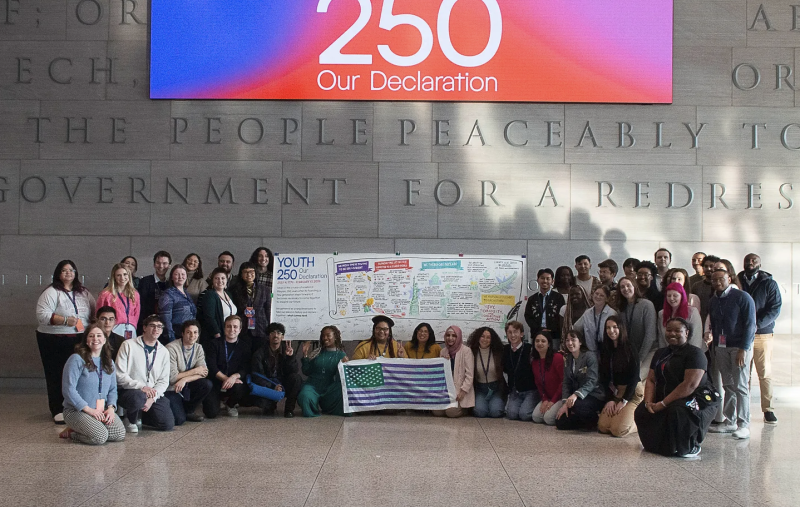
These learning resources are adapted from the Made by US “Youth250: Our Declaration” event, hosted at the National Constitution Center as part of their A250 GenZ engagement events. It is adapted here for classroom use or as part of the Civic Season for summer programs, youth groups, and others to adapt.
These Learning Resources also use the See–Think–Wonder protocol developed by the Harvard School of Education’s Project Zero to examine the opening lines of the Declaration of Independence. Participants are encouraged to use the Turn and Talk strategy for 1:1 discussions.
A graphic organizer is provided to help structure these conversations. Vocabulary terms and words we want students to emphasize may appear in a bold font.
Read for Understanding (for students)
What if today's young people tackled the same big questions as the Founders? Dozens of young adults from across the country did exactly that — debating what truths matter most to their generation, calling out broken systems, and writing declarations for the future they want to build. Now it's your turn. This activity will guide your group through the same process: defining your self-evident truths, naming your grievances, and drafting your own declaration for the future.
Engage:
What values do you believe should define your community or generation?
Nearly 250 years ago, a group of leaders wrote the Declaration of Independence to explain their beliefs, the problems they saw in their society, and the future they hoped to create. The document followed a clear structure:
- First, it named shared values and beliefs.
- Next, it described the realities that violated those values.
- Finally, it declared a vision for a different future.
In this lesson, you will follow a similar structure to create a collective declaration about the future of your community.
Before writing your own declaration, we will examine the opening section of the Declaration of Independence. Pay attention to the way the authors describe their beliefs and values.
Your teacher may display or read the following excerpt:
“We hold these truths to be self-evident, that all men are created equal…”
This opening statement names a core belief about equality and human rights.
See–Think–Wonder Protocol
To begin thinking about values and beliefs, you will use the See–Think–Wonder protocol to examine the opening lines of the Declaration of Independence.
Directions:
Use this graphic organizer as provided by your teacher to record your responses.
SEE:
What words, phrases, or ideas stand out to you in the text?
THINK:
What do you think the authors were trying to communicate about their values or beliefs?
WONDER:
What questions do you have about the ideas expressed in the text?
Sharing Your Thinking
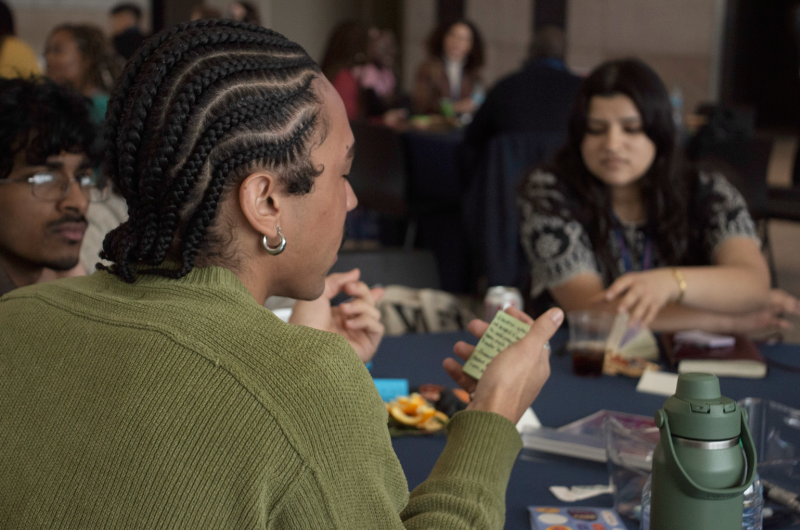
Turn and talk with a partner or small group.
Take turns sharing:
- One thing you noticed
- One idea you thought about
- One question you wondered
Sentence starters:
- “One phrase I noticed was…”
- “I think the authors are trying to say…”
- “I wonder why…”
Remember: the goal is to observe carefully and think deeply, not to find one correct answer.
Transition to the Activity
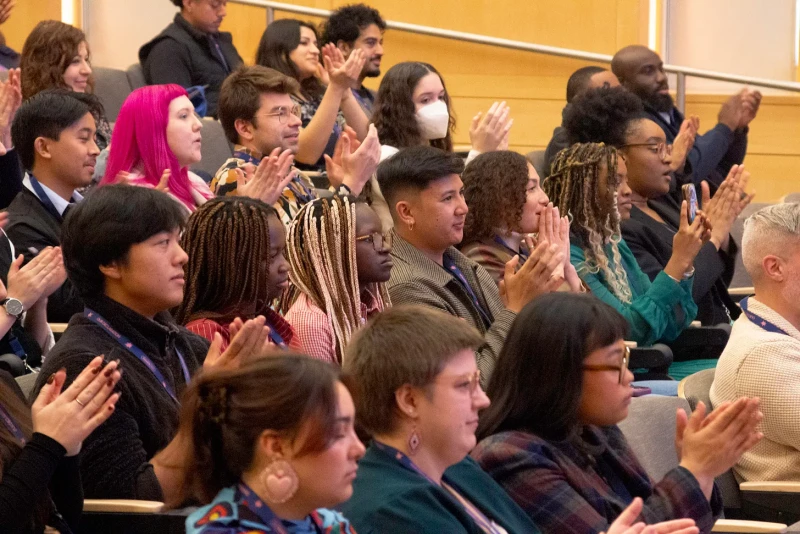
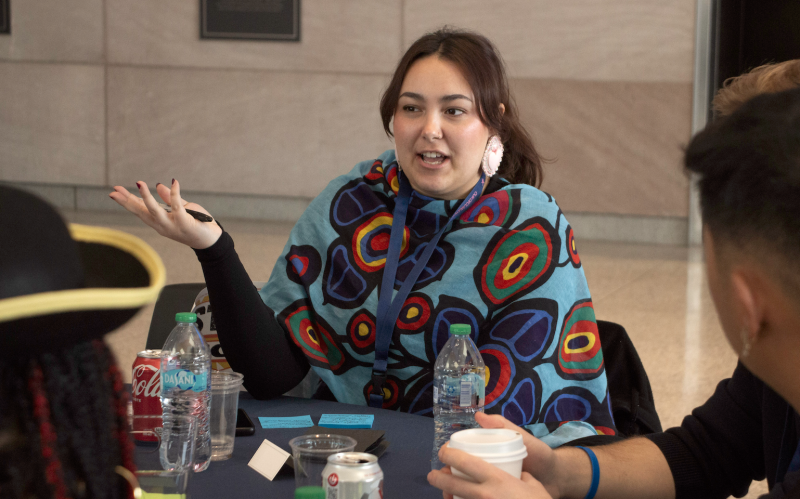
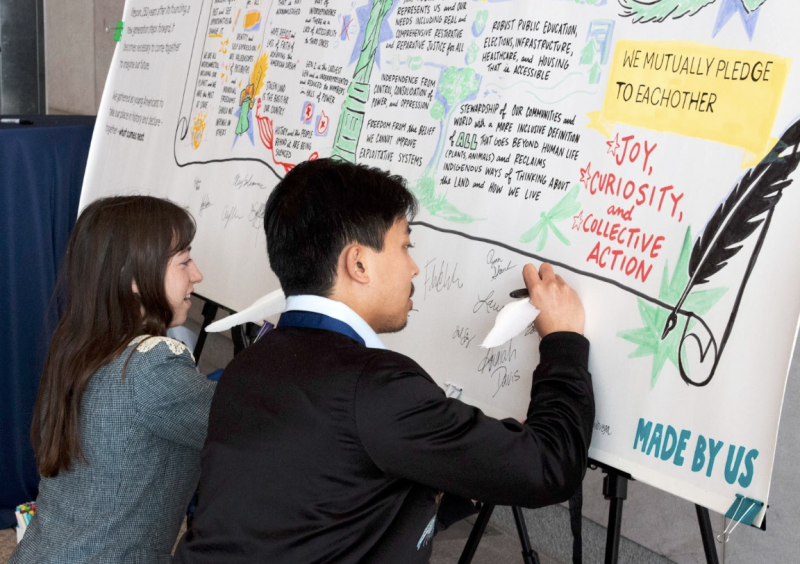
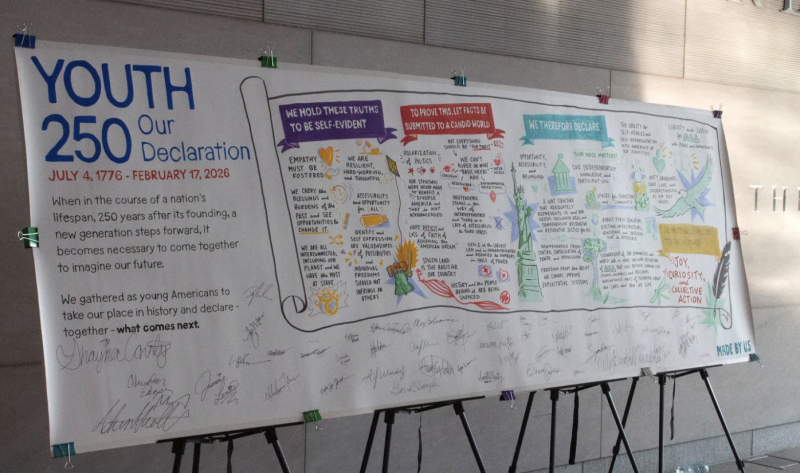
Just like the authors of the Declaration began by naming their beliefs, you will begin by identifying truths or values that should define your community or generation. This activity was inspired by the Made by US Youth250: Our Declaration panel held at the National Constitution Center in Philadelphia as part of Civic Learning Week in the spring of 2026.

Our Declaration - Youth250
The United States turns 250 years old in 2026. Gen Z will write our next chapter.
historymadebyus.org
Your teacher may ask you to record your answers on an exit ticket.
Explore:
What truths or values do you believe should define your community?
Now you will begin writing the first section of your declaration.
This section focuses on values, not problems.
Think about:
- What should be true in a fair and just society?
- What do people often misunderstand about your community?
- What values do you believe are essential for the future?
Individual Reflection
Write five short statements beginning with one of these phrases:
- “We believe…”
- “We know…”
- “It is self-evident that…”
Examples:
- “We believe every person deserves respect.”
- “It is self-evident that opportunity should be accessible to everyone.”
- “We know young people deserve a voice in decisions that affect their future.”
Try to use clear, direct language.
Avoid writing about problems yet. Focus only on what should be true.
Small Group Collaboration
Form groups of 4–8 students, then share your statements with your group.
As you listen to one another:
- Look for similar ideas or themes
- Notice the values that many people share
Together, choose five statements that best represent your group’s shared beliefs.
Write these statements on a large sheet of paper or a shared document.
Whole-Class Discussion
Each group will share their selected statements with the class. Your teacher may record or cluster similar ideas on the board or wall.
Look for patterns such as:
- fairness
- opportunity
- respect
- belonging
- voice
These shared ideas will form the opening section of the class declaration.
Your teacher may ask you to record your answers on an exit ticket.
Explain:
What realities make it difficult for those values to exist in everyday life?
In the Declaration of Independence, the authors did not stop after naming their beliefs. They also described the real conditions that prevented those values from being fulfilled.
They wrote:
“To prove this, let facts be submitted to a candid world.”
This section presented evidence about the realities people faced.
You will now identify realities that challenge the values you discussed.
Individual Reflection
Write five short phrases describing realities you see in your community.
Prompts:
- What systems make it hard to live out your values?
- Where do people feel unheard or misrepresented?
- What issues do people avoid talking about honestly?
Examples:
- unequal access to resources
- lack of youth representation in decision-making
- misinformation and division
- barriers to education or opportunity
Keep your responses short and specific.
Small Group Discussion
Share your ideas with your group. Together, identify patterns across your responses.
Choose five realities that your group believes are most important to acknowledge. Write these on your group sheet.
Whole-Class Reflection
Groups will share their realities with the class. Your teacher will cluster similar ideas on the board or wall.
As you listen, consider:
- What patterns do you notice?
- Are certain issues mentioned by many groups?
These statements will form the “evidence” section of your declaration.
Your teacher may ask you to record your answers on an exit ticket.
Elaborate:
How can communities transform values and challenges into commitments for the future?
Declarations do more than describe problems. They also commit people to building something new.
You will now write the final section of your declaration, focusing on commitments and actions.
Individual Writing
Write 3–5 statements beginning with:
- “We declare…”
- “We will…”
- “We commit to…”
Examples:
- “We declare that every voice deserves to be heard.”
- “We commit to building communities rooted in respect.”
- “We will work to create opportunities for future generations.”
Try to focus on solutions, possibilities, and responsibilities. Avoid statements that only describe what you oppose.
Small Group Drafting
Share your declarations with your group.
Together:
- Refine your language
- Combine ideas where possible
- Choose the five strongest statements
Write your final declarations on your group sheet.
Whole-Class Compilation
Each group will read its declarations aloud. Your teacher may cluster similar statements on the board. These ideas will become the core commitments of your class declaration.
Sentence Frames:
- “One declaration our group created was…”
- “We believe this commitment matters because…”
Your teacher may ask you to record your answers on an exit ticket.
Extend:
What responsibility do individuals have to help turn shared commitments into action?
The Declaration of Independence ended with a powerful pledge:
“We mutually pledge to each other…”
The authors recognized that their declaration required personal responsibility and commitment.
Now you will consider your own role.
Personal Reflection
Write 1–3 words describing something you personally commit to doing.
Examples:
- listen
- participate
- organize
Your teacher may collect these words and display them alongside the class declaration.
Final Reading
To conclude the activity, your teacher will read aloud:
- The shared truths identified by the class
- The realities students discussed
- The final declarations were created together
- The commitment words contributed by students
This reading represents your class’s collective declaration for the future.
Final Reflection
Write 2–3 sentences responding to this question:
How can young people use their voices to shape the future of their communities?
Sentence Frames:
- “One thing I learned from this activity was…”
- “A declaration matters because…”
- “Young people can shape the future by…”
Your teacher may ask you to record your answers on an exit ticket.
Optional: Display & Public Engagement
Teachers may choose to share the class declaration beyond the classroom by:
- Creating a large printed poster or classroom display
- Inviting other students or visitors to add sticky note responses
- Posting the declaration in a school hallway or on a digital platform
- Adding a QR code that links to:
- A reflection survey
- Student writing
- Additional declarations from other classes or communities
- Submit to Made By Us’ Letter to America Campaign for Youth Takeover Day
This helps students see their civic voice as part of a larger national conversation about the future.
Citations:
Edgar, Alex. "What Gen Z Is Declaring at America's 250th." Can We Talk? It's Gen Z. Substack, February 26, 2026. https://canwetalkgenz.substack.com/p/what-gen-z-is-declaring-at-americas.
View this Learning Resource as a Google Doc