

This work by New American History is licensed under a Attribution-NonCommercial-ShareAlike 4.0 (CC BY-NC-SA 4.0) International License. Permissions beyond the scope of this license may be available at newamericanhistory.org.
The Museum That Heals
How Vietnam War veterans used a backyard barn shed to share stories of a complicated past, by Matt Deegan
Chapter 1 Excerpt
This excerpt is used with the permission of the author and may not be redistributed or reproduced in any way or on any platform, per copyright law.
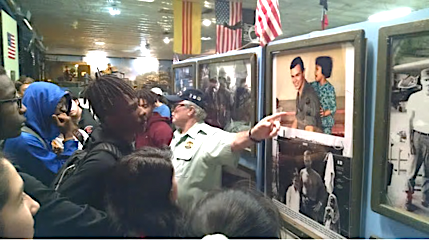
The high school students climbed out of their buses, wearing curious glances as a group of gray-haired war veterans wearing ball caps greeted them. There and then, one group with a lifetime of stories to share met another that was just starting to form their understanding of the world.
One of the veterans in the fray was Craig LaMountain. He encouraged this meeting. And many like it. After all, Craig built the museum on his Ruckersville, Virginia land, which he bought after he retired. He stocked it not with sleek touch-screen kiosks or celebrity-narrated documentary clips. Rather, he filled it with pieces of his own humanity – his draft letter, a Western Union telegram informing of his brother’s death – and with tangible, tactile reminders that a war zone can also be a soldier’s home: a food-ration kit, a 400-gallon water tank called a buffalo, a bunk bed. Craig also invited other local Vietnam veterans to contribute their own artifacts and help lead tours using their own personal stories.
For Craig, his experiences with the Vietnam War embittered him into action.
Craig was drafted into the war. He landed in Vietnam in August 1967 on his 20th birthday, a green G.I. from Long Island, New York. After he returned, his older brother Vetal was deployed as a Navy pilot. Vetal crashed at sea while on a top-secret mission flying between the Philippines and Saigon, shuttling cryptographic technicians to a Navy aircraft carrier. His remains have not been found. Since the mission was classified and the plane went down outside of Vietnam’s official “combat zone”, the Navy would not allow Vetal’s name on the wall at the Vietnam Veterans Memorial in Washington, D.C.
“When I got home [from Vietnam], I was so discouraged,” Craig said, “because life was so normal. Meanwhile, my buddies had been dying overseas…My brother died, no recognition. My cousin came back and was eaten up by Agent Orange [a toxic chemical used to strip leaves from vegetation to expose enemy troops]. I said, ‘Somebody has to do something.’”
So Craig acted, to honor his brother and to ensure that the Vietnam soldier was able to share his side of the story. To act, he turned to education. First, by visiting schools as a guest teacher. Then, by building his museum.
Craig’s cousin was a history teacher on Long Island in New York, and in 1996, the Vietnam War wasn’t being taught much in the local school district, Craig said. So he started speaking directly with students, sharing a slideshow and passing around artifacts that brought to life his own Vietnam stories. He especially caught students’ attention when he would drive up to the school with a Huey helicopter tied to a flatbed trailer. The retired auto mechanic had saved the chopper from the scrap heap. The U.S. government planned on throwing it away, but Craig convinced officials to let him restore it to look as it had when it flew in Vietnam. They agreed, as long as he used it exclusively as a teaching tool.
The school district videotaped Craig presenting his stories, and the recording soon circulated among the schools in the area. Building on his guest lecturing, his intimate museum in Virginia became a place where war could be touched, seen, and heard, in many more dimensions than a slide show or a textbook.
“What was life like before you traveled to Vietnam?” asked Charlottesville High School sophomores Michelle Williams and Nicole Johnson* at his museum that morning.
“It was fun,” LaMountain said. “It was like with you guys: thinking about getting your driver’s license. Thinking, ‘I got a car, I’m going to make it go fast. I’ve got my girlfriend sitting next to me.’ Go to the movies, go to White Castle.”
“Did you have a girlfriend?” Michelle asked.
“Yeah, but it didn’t last,” LaMountain said, a little tongue-tied by the question. “After a couple months over there…Let’s face it, the girls were 16, 17, 18. They’ve got their lives. They’re not going to sit there and wait.”
Michelle and Nicole were two of the 300 students from my history classes at Charlottesville High School who visited Craig’s museum over the course of five years. They would rotate through displays organized by theme: The Homefront (What did a movie ticket cost in 1968? Answer: $1.31), Basic Training (How did you make your bed to the liking of your drill sergeant? Answer: Fold the blanket tight enough so you could bounce a quarter off of it.), and Tour of Duty (How do you land a Huey helicopter in a jungle? Short Answer: Carefully.) After taking the veteran-guided tour, the students found a nook or cranny on the grounds and then led an interview with one of the veterans, asking questions they had prepared days before.
“When I’m asked what [the museum] means to me, I really don’t have an answer,” Craig said. “I can say doing this gives me a warm feeling. This is where I spend 99 percent of my time, either cleaning things or coming up with ideas or remembering.”
That warm feeling melted the built-up bitterness, on display when Craig would say things like: “You have to remember: This is the only war in history where they blamed the soldiers.”
Those who feel slighted can come to think that their full humanity has not been recognized. They feel unseen, unheard, unappreciated. Craig’s museum showed visitors the Vietnam soldier’s humanity and it reminded veterans of their own. It was medicine for the embittered, restless soul, for the unique scars that war etches on the soldier’s psyche. A story seldom told or a reunion with a person – or an object – soothed in a way a pill or a prescription drug could not.
At the museum, tour guide Bill Fields told the story of handing out candy to Vietnamese orphans at a local orphanage as he pointed to photos of a younger him doing so. The war created tens of thousands of orphans, and Bill felt compelled to help. Soldiers aren’t cold-hearted killing machines, his story said.
The museum reunited an Army medic with the helicopter pilot who saved his life. Mike DeFazio was shot in the chest after his unit was ambushed by a Viet Cong battalion that was hiding in a small village. Bob Barrett piloted the medevac chopper that swooped down and lifted Mike away to safety. A surgeon later said he had five minutes to live when Bob landed him at the hospital. Forty seven years later, Bill Fields used Facebook to connect Mike and Bob. The museum hosted the trio’s meet-up, and Mike finally thanked Bob face-to-face.
The museum also reunited a pilot with the Huey helicopter he had flown on hundreds of combat missions in Vietnam. Bob Ford had attacked enemy positions, evacuated the wounded from battle, and shuttled troops into combat with the chopper. Forty years later, he sat in the same commander’s seat, with his daughter Amy beside him listening to his stories from the co-pilot seat. A father remembers defining moments in his life, while a daughter relives it with him.
The makeshift spirit of Craig’s museum made it easy for fellow veterans to contribute directly and candidly, in their own way. Craig also encouraged them to pitch in their talents to remodel his farm warehouse. The veterans eagerly obliged and went to work. Some painted Vietnam’s landscapes on the walls. Some built extra rooms or welded. Others took road trips to retrieve an artifact or save a vehicle that was otherwise destined for the junkyard. These joint building projects and long car rides bonded the veterans in ways more casual than a VFW or American Legion meeting.
“If you ask the [veteran] volunteers, they’d say that if you showed up more than once, you were a part of it, an official, full-time member,” said Dick Thompson, one of Craig’s first volunteers and fellow Vietnam veteran.
For Dick, a pilot in Vietnam, he was hooked after one trip to Craig’s house. One conversation. One look at the Huey Craig had rescued.
Dick had read about Craig in January 2008 in a local newspaper feature that commemorated the 40th anniversary of the Tet Offensive, a turning point in the war in which the North Vietnamese coordinated with Viet Cong guerilla units to attack 39 of South Vietnam's 44 provincial capitals in the span of two days. Craig’s base camp in Chu Lai was one of the first areas hit in the attack.
The article chronicled Craig’s outreach with schools, and that section of the piece inspired Dick to comb through his own attic, dust off his Vietnam flight gear, and drive out to Craig’s house to donate it to the cause. And also to glimpse a Huey, which Dick had flown during his second tour.
“I wanted to dump some stuff off, and I wanted to obviously see the Huey, to stick my head in there,” Dick said.
It turned out to be more than a quick peek at an aircraft. Once Dick saw Craig’s helicopter and his other artifacts in the barn and learned of his vision to start a museum, he jumped into the project immediately.
“We mutually hit it off, and we just started working together on it,” Dick said. “And that’s how it really all came together. Craig came up with great ideas and the rest of us just made it happen.”
They formed a Board, became a certified nonprofit, and opened the museum in 2009. There was no complex business plan, no organizational hierarchy, no ticket office. It was a word-of-mouth operation, anchored by hands-on displays and candid stories.
And LaMountain had a rapt audience in teenagers, who are uniquely hungry for candor as they shape their understanding of the world. It’s what made their extended sit-down interviews special; they forced students into a conversation with the past: What were the struggles? How did you overcome them? What were the limits to that overcoming? The Vietnam veterans were walking, talking founts of memories who breathed life and therefore relevance into a historical topic that would otherwise be just another static page in a textbook for a 16-year-old, not a lived experience.
LaMountain continued his interview with Michelle and Nicole. He told his story. They listened. And asked more questions.
“How did you feel when you arrived in Vietnam?” the two teenagers asked.
“Scared to hell,” LaMountain replied. “I saw things I should never have to see.”
In September 2015, Craig wrote a rough script for his tour guides, adding meticulous details about weapons and food, but also sprinkling in personal memories and commentary. It reads like a mix of encyclopedia article and diary entry. He ended the script with a request for visitors:
“We don’t know whether anybody learned anything or not. But it’s your job to never forget.”
Experienced classroom teachers recognize that you will never truly know what sticks with your students after your time with them. You hope that a nugget of knowledge, a developed skill, or a word of wisdom lingers and proves useful. It was the same with LaMountain and his museum. He wanted a space to teach on his terms and to hope some of his lessons stuck and could be passed on.
Even with today’s tech wizardry, the best way to pass on important lessons is to sit eyeball-to-eyeball with another person and exchange stories. It’s as timeless and low-tech as the campfire circle. It’s the best way to ensure that people know they’re being heard and seen. And it is with this spirit that this book exists. It attempts to highlight the humanity of the individual veteran, and to deepen an appreciation for the idea of fulfilling a duty to serve a cause greater than self, even when you don’t always agree with every decision along the way.
More broadly, it aims to remind teachers, students, and any curious person that there is much to learn from elders in our communities, be they military veterans, civil rights fighters, civic or spiritual guides, or matriarchs or patriarchs in our families. What if we sat and truly listened to their stories? We would stop acting like children, according to Cicero, the statesman and philosopher from Ancient Rome.
“To be ignorant of what occurred before you were born,” Cicero said, “is to remain always a child. For what is the worth of human life, unless it is woven into the life of our ancestors by the records of history?”*
By making meaning out of an elder’s life story, we might absorb the wisdom that only a lifetime of experiences can reveal. And as for the elders telling the stories – folks who may have carried long-ago slights into their older years or who may worry that their efforts were in vain – they will walk away with a renewed sense that their struggles and strivings had value. For all involved, it can be a powerful give and take. And Craig LaMountain’s Vietnam museum in Ruckersville, Virginia, was a place that invited the kind of storytelling that could make us all wiser and feel more valued.