

This work by New American History is licensed under a Attribution-NonCommercial-ShareAlike 4.0 (CC BY-NC-SA 4.0) International License. Permissions beyond the scope of this license may be available at newamericanhistory.org.
American Visions: William Apess
A Son of the Forest
Key Vocabulary
Activist – a person who campaigns to bring about political or social change.
Advocate – to publicly recommend or support.
Ancestry – one's family or ethnic descent; the origin or background of someone.
Antebellum – occurring or existing before a particular war, especially the American Civil War.
Assimilation – the process of adopting the language and culture of a dominant social group or nation, or the state of being socially integrated into the culture of the dominant group in a society.
Autobiography – an account of a person's life written by that person.
Boast – talk with excessive pride about one's achievements or abilities.
Christian charity – a theological virtue that signifies a gift for humanitarian, philanthropic, or other purposes beneficial to the public.
Compromise – an agreement or a settlement of a dispute that is reached by each side making concessions.
Concessions - a thing that is granted, especially in response to demands; a thing conceded.
Connotation - the emotional, cultural, or implied meaning of a word, in addition to its literal dictionary definition.
Conversion – the fact of changing one's religion or beliefs or the action of persuading someone else to change theirs.
Conviction – a firmly held belief or opinion.
Cultivation – prepare and use (land) for crops or gardening
Degradation – the act of lowering something or someone to a less respected state.
Descendant – a person who is descended from a specific ancestor or group of ancestors.
Displacement – the forced movement of individuals from their homes or habitual residences, either within their own country or across borders, due to various factors like conflict, violence, natural disasters, or human-made disasters.
Dominant – having primary control, authority, or influence over others.
Estimation – a rough calculation of the value, number, quantity, or extent of something.
Extraction – the ethnic origin of someone's family.
Heaped – to gather things into a pile or mound, often in large quantities.
Heritage – practices or characteristics that are passed down through the years, from one generation to the next.
Hesitate – pause before saying or doing something, especially due to uncertainty.
Hypocrisy – the practice of claiming to have moral standards or beliefs that one's own behavior does not conform to.
“Mantle of Prejudice” – describes the way prejudice can act as a pervasive, enveloping force, obscuring or distorting our perceptions of individuals and groups based on preconceived, often negative judgments.
Methodist – a member of a Christian Protestant religion, which started in the 18th-century evangelistic movement.
Minister – a member of the clergy, especially in Protestant churches.
Narrative – a spoken or written account of connected events; a story.
Navigate – to lead a company, activity, etc. in a particular direction, or to deal effectively with a difficult situation.
Noble-hearted – to possess a kind, generous, and honorable disposition.
Op-Ed – An op-ed, originally short for "opposite the editorial page," now mainly taken to mean “editorial opinion,” is a written statement commonly found in newspapers, magazines, and online publications. They usually represent a writer's strong and focused opinion on an issue of relevance to a targeted audience.
Pervade – spread through and be perceived in every part of.
Pequot – an Algonquian-speaking Indigenous people traditionally located in eastern Connecticut.
Prejudice – preconceived opinion that is not based on reason or actual experience.
Progenitor – a person or thing from which a person, animal, or plant is descended; an ancestor or parent.
Promote – further the progress of something, especially a cause, venture, or aim; support or actively encourage.
Providence – the protective care of God or of nature as a spiritual power.
Poverty – a state or condition where individuals lack the resources, particularly financial resources, to meet their basic needs and participate fully in society.
Redress – remedy or set right.
Render – provide or give.
Resistance – the refusal to accept or comply with something; the attempt to prevent something by action or argument.
Sovereign – supreme ruler, or ultimate power.
StoryMap - A tool that combines maps with storytelling, allowing the user to visually showcase a narrative or information related to specific locations.
Subject – a person under the authority of someone else.
Systemic Racism - a form of racism embedded as normal practice in society, rooted in policy and law.
Temperance – the quality of moderation or self-restraint.
Transformation – a thorough or dramatic change.
"Tree of distinction" – can be used as a metaphor to represent things that are set apart, unique, or hold a special status.
Uncharitable – unkind or unsympathetic behavior or attitude toward others.
White Supremacy – the belief that white people constitute a superior race and should therefore dominate society, typically to the exclusion or detriment of other racial and ethnic groups.
Wickedness – the quality of being evil or morally wrong.
Read for Understanding
A Son of the Forest (1831) is the first known autobiography published by a Native American, written by William Apess (1798–1839) , a Pequot minister, writer, and activist. In this deeply personal and political work, Apess shared his life story—from a childhood of poverty, abuse, and displacement to becoming a preacher and outspoken critic of racism and injustice. He challenged white supremacy, defended the rights and dignity of Native peoples, and called for a shared moral responsibility between Indigenous and settler communities.
Apess’s writing helps us better understand early American history from a Native perspective—especially at a time when Indigenous voices were being silenced or erased. His use of Christian language, political critique, and autobiography makes A Son of the Forest a powerful text to explore in relation to questions of identity, belonging, and justice in the United States.
Engage:
How can personal stories challenge the way we understand history and identity?
In his book A Son of the Forest (1829), William Apess shares his life story, from a childhood marked by poverty and racism to his journey toward education, faith, and public speaking. His writing challenged how Americans thought about race, religion, and identity in the early 1800s. Apess used his voice to fight for Native rights and speak out against injustice, making him a bold and important figure in American history.
While you may occasionally see the historical variant spelling "William Apes" in older texts, modern scholars, publishers, and Native American studies departments predominantly use the double "s" format (Apess) to honor how the Pequot activist and writer spelled his own name later in his life. The variation exists because William Apess changed the spelling himself during his lifetime, and 19th-century printing practices were highly inconsistent. By the mid-1830s, Apes added the second "s" to write it as Apess. Historians suggest he did this to ensure proper pronunciation and to distance his name from the English animal word, apes, which carried racist connotations. It is also worth remembering that in the 1800s standardized spelling did not exist. Printers, census takers, and public records frequently misspelled names based on how they sounded.
Take a few minutes to observe the following images:
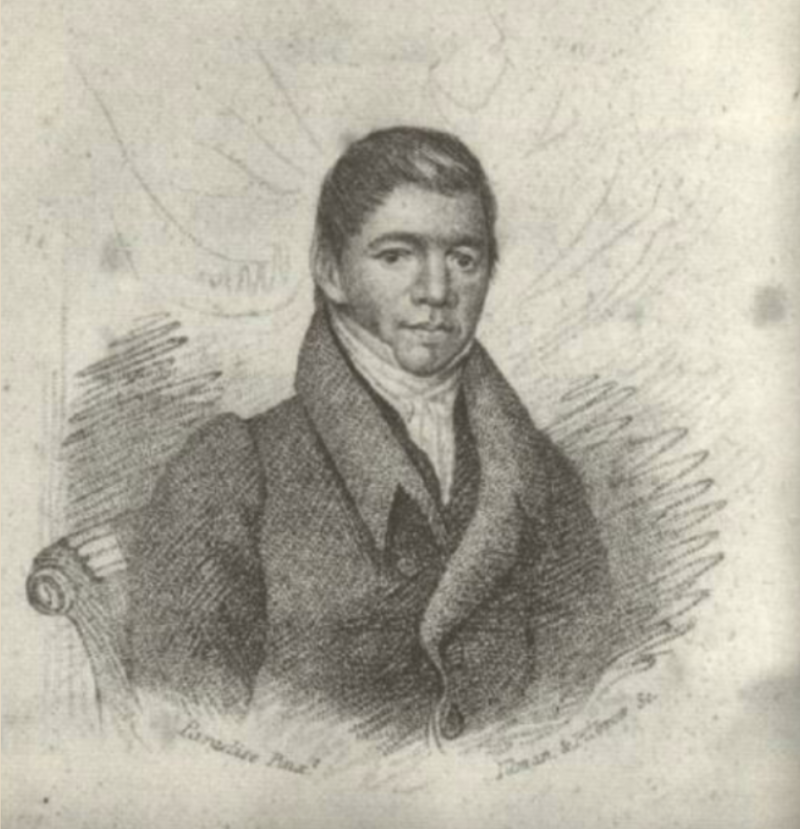
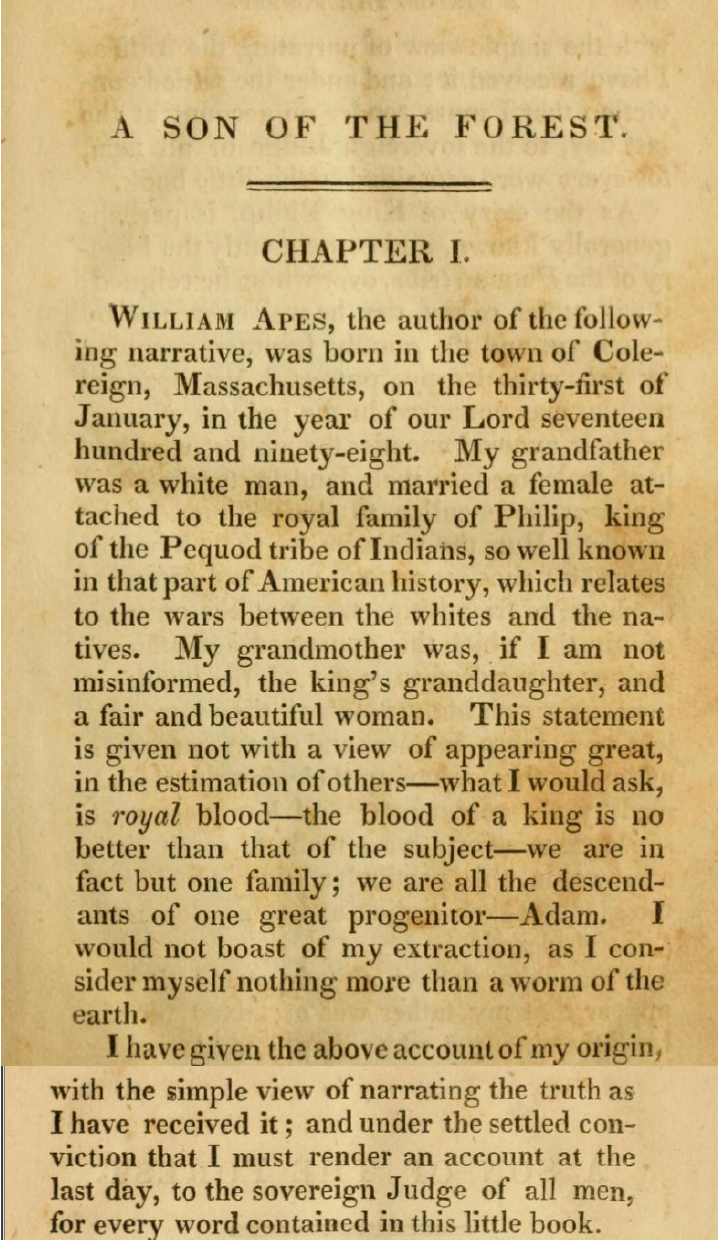
Directions: Answer these questions after you’ve read Chapter 1 and made observations about the image and text from Apess’ “Son of the Forest”:
- What do you notice about the way Apess is dressed?
- How would you describe his expression or posture?
- What does this portrait suggest about how Apess wanted to be seen?
- What information does this short excerpt provide about William Apess and his writing?
Sentence Frames:
- I notice that he is wearing _________.
- His expression and his posture tell me that ________.
- This portrait suggests that Apess wanted to be seen as ___________.
- This short excerpt tells me that _________.
Use the Give One/Get One protocol to exchange ideas with a classmate (or two) and record their answers below using the graphic organizer provided. You may make a digital copy, or use a paper copy provided by your teacher.
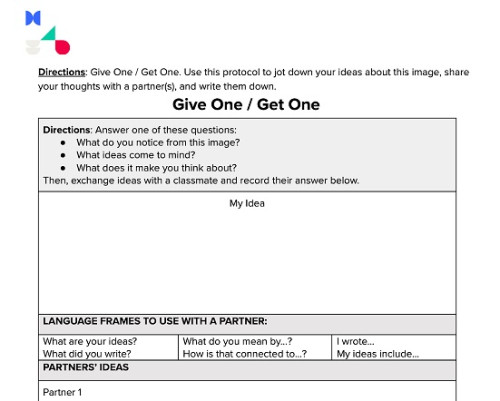
NAH Give One, Get One: William Apess
“A Son of the Forest” William Apess (1831) Make a copy of this graphic organizer to record your responses, or use a paper copy provided by your teacher.
docs.google.com
Your teacher may ask you to record your answers on an exit ticket.
Explore:
In what ways does William Apess use his life story to expose injustice and redefine what it means to be American?
Watch this video interpretation from American Visions about William Apess.
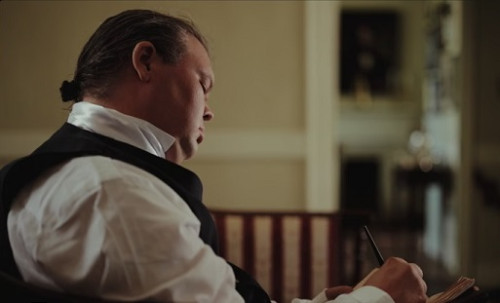
William Apess
As a traveling Methodist minister of Native American descent, William Apess fired his pulpits with impassioned pleas for white Americans to treat Native people with equality and respect.
visions.newamericanhistory.org
Consider the questions he poses as you read this Bunk article, “The Greatest Native American Intellectual You’ve Never Heard Of,” to learn about William Apess’s journey into Christianity and Methodist teachings.
Directions: Discuss the following questions with a partner –
- How does the article characterize William Apess’s influence and significance in antebellum American reform movements?
- What does the article reveal about Apess’s early life and upbringing, and how might these experiences have shaped his later activism and writing?
- How did William Apess use his identity—as a Pequot, as a Methodist preacher, and as a reform advocate—to challenge enduring ideas of American democracy and racial equality?
- Despite his accomplishments, why does the article suggest William Apess remains relatively unknown today?
You may also explore more about William Apess and others who advocated for the rights of Indigenous peoples in this StoryMap from the American Visions digital humanities project.
Take notes using the S-I-T Strategy on the information you are most interested in exploring. Your teacher may provide a paper copy of the graphic organizer or allow you to make a digital copy.
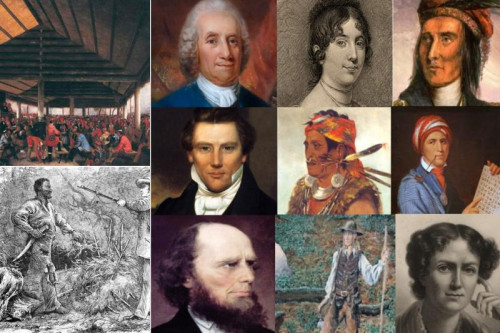
American Visions
A StoryMap Companion
storymaps.arcgis.com
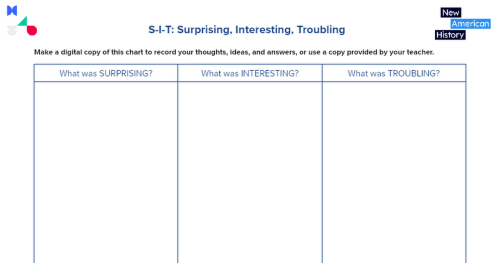
NAH S-I-T: Surprising, Interesting, Troubling
Make a digital copy of this chart to record your thoughts, ideas, and answers, or use a copy provided by your teacher.
docs.google.com
Your teacher may ask you to record your answers on an exit ticket.
Explain:
How does William Apess use his personal story to argue against racism and redefine Native identity in early America?
You will use the Reciprocal Teaching Protocol in small groups to discuss your understanding of the images and documents you have analyzed so far from Bunk and the American Visions digital humanities project. You may view the video or StoryMap again for additional context. Use this template to record your responses. You may make a digital copy, or use a paper copy provided by your teacher.
Reciprocal Teaching is a group reading strategy where everyone takes on a role to help the group better understand a text or video. Each person within the group has a role:
- Questioner – Asks big or tricky questions about the text to spark discussion.
- Summarizer – Gives a quick recap of the most important ideas.
- Clarifier – Clears up confusing words, phrases, or sections.
- Connector – Makes connections between the text and real life, other readings, or personal experiences.
By working together and rotating roles, everyone builds a deeper understanding—and helps teach each other!
Choose Roles in Small Groups: Each of you will choose one of the following roles:
Rotate roles in later rounds so that you may each have the opportunity to try each one.
1) Questioner – Pose deep, open-ended questions to drive discussion:
- Why might Apess choose to convert to Christianity even though it was the religion of colonizers?
- How do you think Apess balances his identity as a Native person with his Christian beliefs?
- In what ways do you think Apess’s writing challenges dominant ideas of race and religion in early America?
- Why do you think Dura emphasizes the “political” nature of Apess’s conversion?
2) Summarizer – Briefly identify the main ideas and key points:
- What are the central events Apess describes related to his religious conversion and personal transformation?
- Summarize how Apess explains his feelings about being a Native American growing up in a predominantly white Christian society.
- What does Dura suggest is significant about Apess’s conversion experience, and how does that shape his later activism?
3) Clarifier – Clear up confusion or difficult language:
- Are there any unfamiliar terms or references in Son of the Forest (e.g., “Methodist,” “camp meeting,” “temperance”)? Let’s define them.
- What does Apess mean when he describes his “new heart”? How does this language reflect the religious culture of the time?
4) Connector – Link ideas from the text to personal experience, other texts, or current events:
- Can you connect Apess’s experience of identity conflict to any other figures in history or literature who struggle with belonging?
- How do Apess’s experiences remind you of modern debates around assimilation and cultural preservation?
- In what ways do contemporary Indigenous activists use personal storytelling like Apess did?
Rotate roles in later rounds so that you may each have the opportunity to try each one.
Whole-Class Reflection: After small-group discussions, come together to reflect:
- How does William Apess use religion both as a tool for personal transformation and as a form of resistance?
- What does Apess’s story reveal about the challenges of navigating identity in a society that devalues your culture?
- Do you think Apess’s assimilation of Christianity strengthened or complicated his Native identity? Why?
- In what ways can personal stories—like Son of the Forest—challenge dominant narratives in history?
- How might William Apess’s experiences connect to modern stories of people caught between cultures or trying to preserve their heritage?
Sentence Frames:
- William Apess uses religion as both a tool for personal transformation and as a form of resistance by _______________.
- Apess’s story reveals the challenges of navigating identity in a society that devalues your culture because _____________.
- I think Apess’s assimilation of Christianity is [strengthened OR complicated] by his Native identity because ___________.
- Personal stories—like Son of the Forest—can challenge dominant narratives in history by _____________.
- William Apess’s experiences connect to modern stories of people caught between cultures or trying to preserve their heritage because it ______________.
Consider this question as a final reflection:
How does William Apess’s story influence your understanding of the importance of perspective when reading historical accounts?
Your teacher may ask you to record your answers on an exit ticket.
Elaborate:
How can William Apess’s voice help us understand identity and injustice today?
“Apess Speaks Today”: Writing a Modern-Day Op-Ed Piece
You will take what you have learned about Apess’s life, message, and voice, and imagine how he might speak to a modern audience by responding to current issues of race, religion, or cultural identity.
This will help you:
- Apply your knowledge of Apess’s ideas and rhetorical style.
- Connect the historical ideas to contemporary issues.
- Practice writing with voice, purpose, and perspective.
Directions:
1) Choose a Modern Topic: select a present-day issue that connects to themes from Son of the Forest, such as:
- Cultural erasure or preservation
- Religious freedom
- Systemic racism
- Native land rights or mascots
- Assimilation and identity
2) Craft the Voice of Apess: Write a short op-ed from William Apess’s perspective on that issue.
You must:
- Use a first-person voice, mimicking Apess’s tone.
- Include references to his life and ideas.
- Draw connections to both past and present injustices.
3) Optional – Gallery Walk:
- Host a class reading and invite other classes/students to share your work.
- Display pieces with quotes from Son of the Forest side-by-side.
Your teacher may ask you to record your answers on an exit ticket.
Extend:
What makes someone part of the American story?
Now that you’ve explored William Apess’s own words and examined how he used his story to challenge injustice, we’ll look at how his legacy is remembered—or forgotten—today.
In this final section, you’ll revisit “The Greatest Native American Intellectual You’ve Never Heard Of,” and ask yourself an important question: Why don’t more people know about William Apess? As you reread, think about who gets included in the American story, who gets left out, and how we decide which voices matter in history.
Re-read this Bunk excerpt, “The Greatest Native American Intellectual You’ve Never Heard Of.”
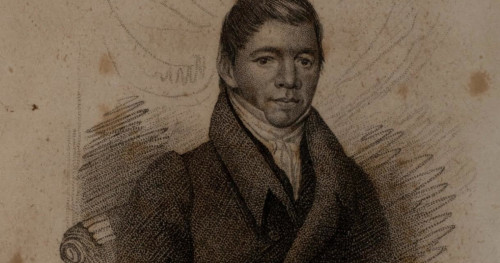
The Greatest Native American Intellectual You’ve Never Heard Of
The short life and long legacy of the 19th-century reformer William Apess.
www.bunkhistory.org
Select the “View Connections” button to explore more excerpts as connected in Bunk. You may choose different icons as you explore. Note the associated tags that connect each excerpt to another. Explore one or more tags.
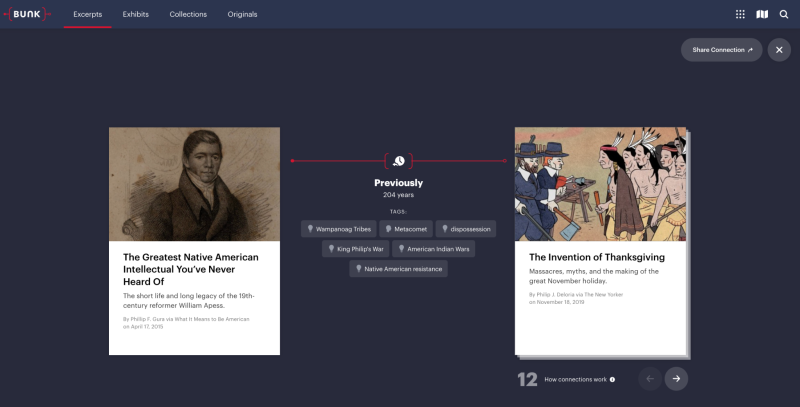
Consider the following questions:
- What surprised you?
- What argument is the author making about Apess and American history?
- What quotes or ideas connect back to Son of the Forest?
- How does this article reshape your understanding of Apess’s legacy?
- What does the author mean by calling him “the greatest Native American intellectual you’ve never heard of”?
- In what ways does Apess challenge dominant definitions of what it means to be American?
- Why do you think Apess has been left out of many U.S. history narratives?
Explore some of the Bunk Connections.
Your teacher may ask you to record your answers on an exit ticket.
Citations:
American Visions: New American History, s.v. “William Apess.” Accessed July 21, 2025. https://visions.newamericanhistory.org/#william-apess.
Apes, William. A Son of the Forest: The Experience of William Apes, a Native of the Forest. New York: The Author, 1831. Accessed July 20, 2025. https://archive.org/details/sonofforestexper00apes/page/10/mode/2up.
Ayers, Edward. American Visions – Chapter 2: Reckonings. October 24, 2023. Accessed July 20, 2025. https://storymaps.arcgis.com/collections/684a16d2ddcb44609011f211e21c6596?item=2
Facing History and Ourselves. “What is the Give One, Get One Strategy?” February 20, 2015. Accessed March 23, 2025. https://www.facinghistory.org/resource-library/give-one-get-one
Gura, Philip F. “The Greatest Native American Intellectual You’ve Never Heard Of: What It Means to Be American.” Bunk History, April 17, 2015. Accessed July 23, 2025. https://www.bunkhistory.org/resources/the-greatest-native-american-intellectual-youve-never-heard-of-what-it-means-to-be-american.
Keller, Keeley. “10 Reasons You Should Use Sentence Frames In Your Classroom.” TeachingChannel.com. September 9, 2022. Accessed March 23, 2025. https://www.teachingchannel.com/k12-hub/blog/10-reasons-you-should-use-sentence-frames-in-your-classroom/#:~:text=1)
Politzer, Ben. "Reciprocal Teaching," Reading Rockets, last modified April 25, 2019. Accessed June 8, 2025. https://www.readingrockets.org/strategies/reciprocal_teaching.
“S-I-T: Surprising, Interesting, Troubling.” Facing History & Ourselves. Accessed June 17, 2024. https://www.facinghistory.org/resource-library/s-i-t-surprising-interesting-troubling
StoryMap https://storymaps.arcgis.com/collections/684a16d2ddcb44609011f211e21c6596?item=2
The Teacher Toolkit, “Exit Ticket.” Accessed March 23, 2025. https://www.theteachertoolkit.com/index.php/tool/exit-ticket