

This work by New American History is licensed under a Attribution-NonCommercial-ShareAlike 4.0 (CC BY-NC-SA 4.0) International License. Permissions beyond the scope of this license may be available at newamericanhistory.org.
All History is Local: The 1939 Alexandria Library Sit-In

Key Vocabulary
Chicago Defender - founded in 1905 by Robert S. Abbott was once considered the "most important" newspaper of its kind. Abbott's newspaper reported and campaigned against Jim Crow-era violence and urged black people in the American South to settle in the north in what became the Great Migration.
Demographics - statistical data relating to the population and particular groups within it
Discrimination - the unjust or prejudicial treatment of different categories of people, especially on the grounds of ethnicity, age, sex, or disability, often reinforced by state and local laws that enforced segregation.
Integration - creating a society where people of different races have equal opportunity and access to resources, leading to a culture that draws on diverse traditions
Jim Crow Laws - laws to create legally segregated, inherently unequal conditions in the U.S. until overturned by Brown v. Board of Education in 1954.
Legacy - the long-lasting impact of particular events, actions, etc. that took place in the past, or later impacts of a person’s life
Racism - when a group of people is treated unfairly because of their race/skin color
Segregation - the practice of race-based separation in public spaces, including schools, public transportation, restroom facilities, and neighborhoods. Many communities in the United States were segregated for centuries, and while the Civil Rights Movement of the 1960s removed many legal barriers, some are still socially segregated.
"Separate but equal" - a legal rule that allowed states to pass laws requiring Black and white people to use different public facilities originating with the 1896 Supreme Court decision in Plessy v Ferguson. It was the legal backbone of segregation in America for more than 50 years.
Sit-In - to occupy a public space as a form of protest
Think tank - a body of experts providing advice and ideas on specific political or economic problems
Read for Understanding
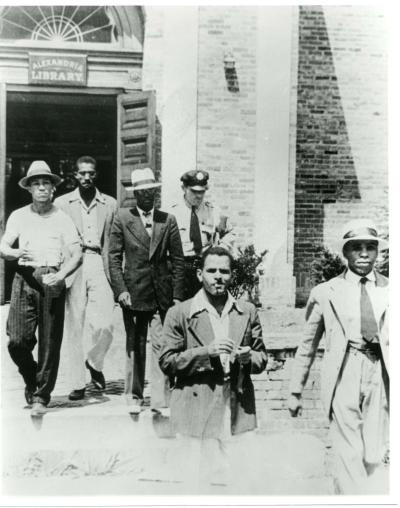
In 1939, a group of young Black men in Alexandria, Virginia, protested the segregation of public places by sitting down in a local library to read. What we call a sit-in became a powerful tool of the later Civil Rights Movement. This lesson tells their story, an early example of the power of peaceful, non-violent protest.
Engage:
What role did the desire to check out library books play in the Civil Rights Movement?
Alexandria, Virginia, became a flashpoint for the fight for civil rights and freedoms for African Americans in the mid-20th century. The fight for greater freedoms and access to better economic and educational opportunities found its leadership in a young lawyer, Samuel Tucker.
What role did the desire to check out books play in helping to start the desegregation battles that will be part of the political, social, and economic landscape in Alexandria, Virginia, and across America in the 1950s and 60s in the segregated South?
Analyze the images below, using the See, Think, Wonder strategy, and record your ideas on the graphic organizer provided. Your teacher may provide a paper copy or allow you to make a digital copy to record your answers.
NAH "See / Think / Wonder" Graphic Organizer
Use the image provided by your teacher to complete the See Think Wonder Graphic Organizer.
docs.google.com
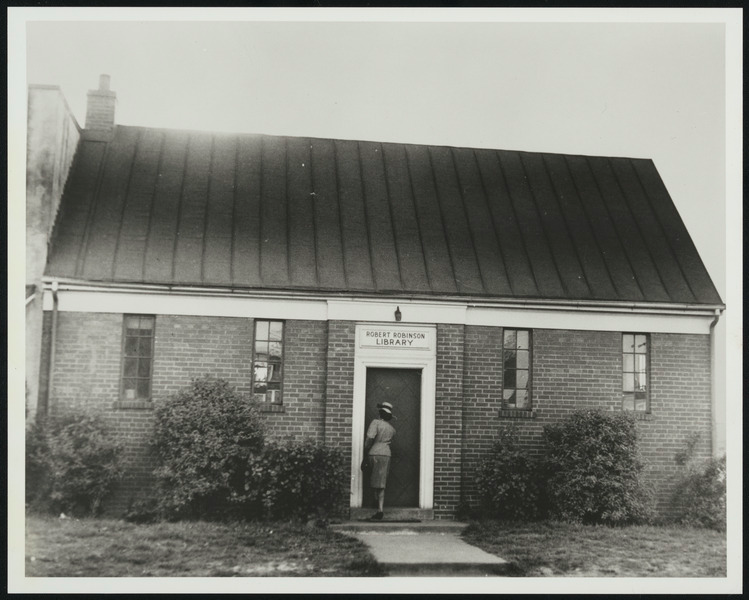
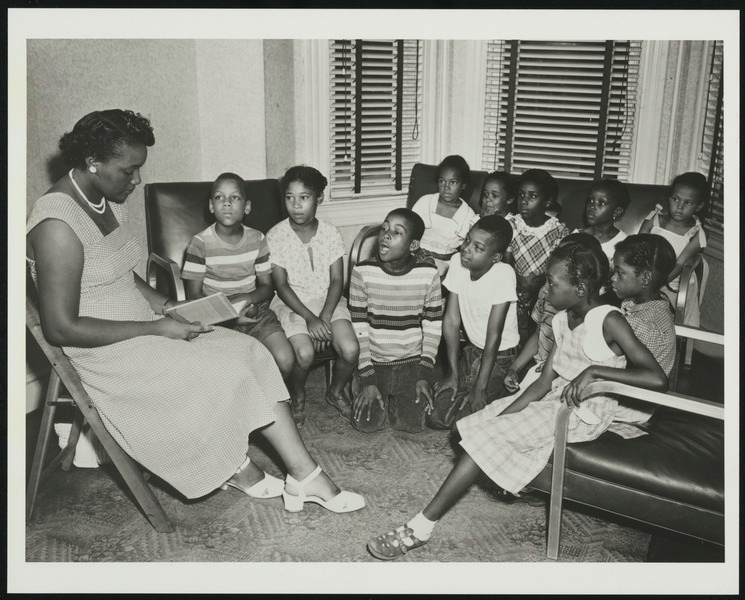
Turn and Talk to a partner as directed by your teacher. Share your See, Think, Wonder reflections.
Context of Images: The images above are of the Robert Robinson Library in Alexandria, Virginia. In 1939, Samuel Tucker and his peers challenged the city to open the city’s first public library—known as the Alexandria Library—to all residents. He helped to organize a sit-in at that library. The sit-in was historic and raised awareness of civil rights issues, but did not immediately lead to integration. In fact, less than a year later, instead of opening the Alexandria Library to all, the city built the Robert Robinson Library for African American residents to avoid integrating the existing Alexandria Library, which was just a few blocks away. Throughout the next decades, libraries and access to them became one of several key stages in the fight for the advancement of African American civil rights. Other examples include bus boycotts and school desegregation.
Your teacher may ask you to record your answers on an exit ticket.
Explore:
Who has the power to make a difference in our communities?
Segregation in Alexandria, Virginia, was part of the broader system of racial segregation and discrimination that persisted in the United States, particularly in the Jim Crow era. African Americans faced severe restrictions on where they could live, work, and access public facilities. In Alexandria, demographic and legal barriers enforced racial separation - impacting housing, education, and public services. Despite these challenges, African American communities in Alexandria also fostered resilience, activism, and efforts toward social change. Segregation officially began to decline after the Civil Rights Movement of the 1960s, leading to more integrated communities.
Use this Google Slides deck to reveal portions of a larger image, answering the questions provided on each slide.

NAH 1939 Alexandria Library Sit-In Visual Discovery LR
Shared for educational purposes only by Nancy Noyes Silcox, author, with permission from the Alexandria Black History Museum. Used with permission – do not republish on any other external site.
docs.google.com
Once you have completed the slide deck activity, read the context statement below and answer the following reflection questions.
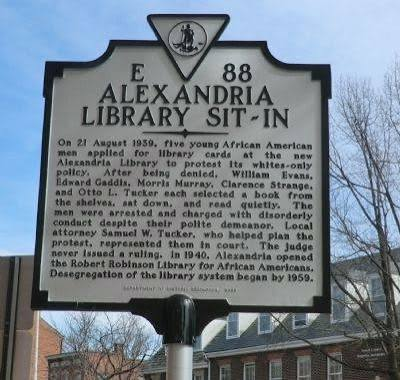
Context: On August 21, 1939, Alexandria Library staff and patrons watched as a young African American entered the library and asked to register for a library card. When the librarian on staff refused, the young man picked up a book, took a seat, and began to read. Minutes later, another well-groomed and polite young adult repeated these actions. This continued until William Evans, Otto L. Tucker (the brother of Samuel W. Tucker, the attorney who argued the case for access ), Edward Gaddis, Morris Murray, and Clarence Strange occupied five tables. Each one sat in silence and read a book. For additional information, visit this entry in Encyclopedia Virginia.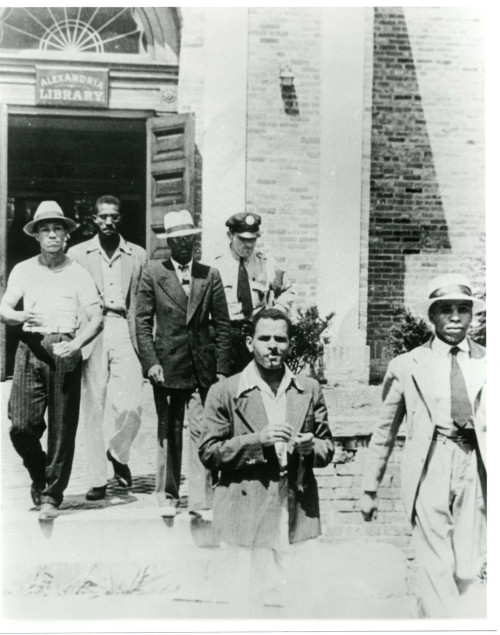
1939 Alexandria Library Sit-In - Encyclopedia Virginia
Alexandria’s first reading room, the Alexandria Library Company, was established in 1794 as a subscription service for the exclusive use of elite white men. Beginning in the nineteenth century, a few elite white women were allowed to use their husbands’ memberships for reading-room privileges, while others joined as members. The library excluded white members of the working class and Black Alexandrians.
encyclopediavirginia.org
Questions:
- Who were the young men who participated in the sit-in, and what was their intention?
- What were the specific actions taken by the protesters, and how did the library staff and police respond?
- What were the charges filed against the protesters, and what was the outcome of those charges?
- What was the state of segregation in Alexandria, Virginia, in 1939, especially regarding the public library?
Your teacher may ask you to record your answers on an exit ticket.
Explain:
How do maps help us visualize and understand social change in our communities?
Map Work: View the StoryMap, Segregated Libraries & Schools in Northern Virginia in the 20th Century.
Segregation in Schools and Libraries in Virginia
The "Why" Behind the Alexandria Library Sit-In of 1939
storymaps.arcgis.com
Use the StoryMap to complete this graphic organizer, analyzing the map and data for Alexandria, Virginia, which is based on a sampling of addresses for schools and libraries in different decades. Your teacher may provide a paper copy or allow you to make a digital copy to record your answers.
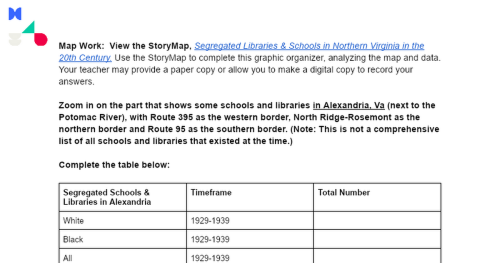
NAH Student Copy - Map Work: Segregated Libraries
Map Work: View the StoryMap, Segregated Libraries & Schools in Northern Virginia in the 20th Century. Use the StoryMap to complete this graphic organizer, analyzing the map and data. Your teacher may provide a paper copy or allow you to make a digital copy to record your answers. Zoom in on the...
docs.google.com
What conclusions can we draw about library usage during this 50-year time period in Alexandria, Virginia for the different demographic groups?
Your teacher may ask you to record your answers on an exit ticket.
Elaborate:
How can individuals act as agents of change to bring about social progress?
The 1939 Alexandria Library Sit-In Opened a New Front in the Civil Rights Movement.
View this short video from PBS:
Reflect on the video before turning and talking with a partner to discuss the following questions:
- What attitude is Mr. Tucker sharing in these statements?
- Why are the statements significant?
Read these quotes attributed to Samuel W. Tucker:
“I got involved in the Civil Rights Movement on June 18, 1913, in Alexandria. I was born black.”
“I refuse and will always refuse to accept a card in lieu of a card to be used at the existing library on Queen Street…”
Use the Step In - Step Out - Step Back thinking routine to reflect on each of the quotes.
- Step In: Based on what you know right now, what do you think Tucker might have felt, believed, known, or experienced when he wrote these statements?
- Step Out: What else would you like or need to learn to understand Tucker’s perspective better?
- Step Back: Given your exploration of this perspective so far, what do you notice about your own perspective and what it takes to think about somebody else’s perspective?
Use this graphic organizer to complete a Quick Write/Quick Draw about your perspective on the quotes you analyzed and what you have learned about Samuel W. Tucker and the 1939 Alexandria Library Sit-In.
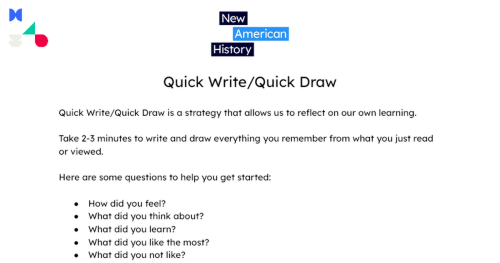
NAH Quick Write/Quick Draw
Quick Write/Quick Draw Quick Write/Quick Draw is a strategy that allows us to reflect on our own learning. Take 2-3 minutes to write and draw everything you remember from what you just read or viewed.
docs.google.com
Final Reflection:
Synthesize what you have learned about the 1939 Alexandria Library Sit-In, and reflect on this statement by author, scholar, and early civil rights leader, W.E.B. Du Bois:
“The slave went free, stood a brief moment in the sun; then moved back again toward slavery.”
Your teacher may ask you to record your answers on an exit ticket.
Extend:
How do the actions of Samuel Tucker and his friends in 1939 serve as a model for the Civil Rights Movement of the 1950s-60s?
Read this excerpt from Samuel Wilbert Tucker: The Story of a Civil Rights Trailblazer and the 1939 Alexandria Library Sit-In, by Nancy Noyes Silcox. Silcox is a former school librarian at Samuel W. Tucker Elementary School in Alexandria, Virginia.
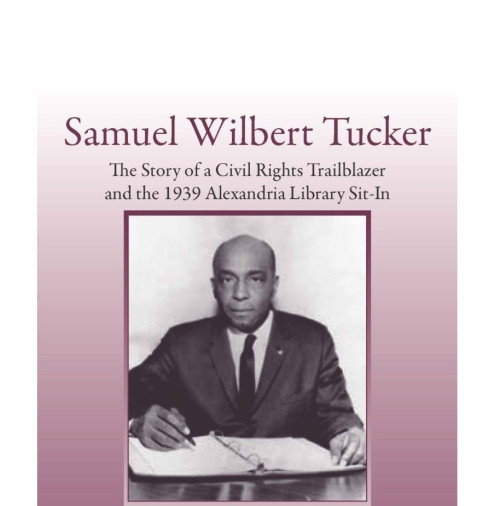
Samuel and the Library Sit-In
An excerpt from Samuel Wilbert Tucker: The Story of a Civil Rights Trailblazer and the 1939 Alexandria Library Sit-In by Nancy Noyes Silcox
resources.newamericanhistory.org
Use these resources, curated by New America (an American think tank), the Alexandria Library resources, and this entry from Encyclopedia Virginia to further explore the life of Samuel W. Tucker.
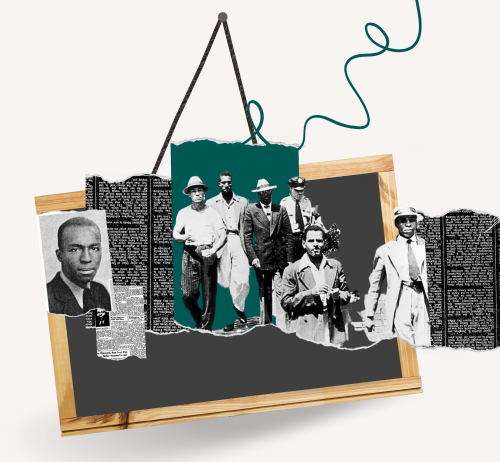
The 1939 Library Sit-In Project
A growing collection of video interviews, events, articles, and other materials related to the library sit-in of 1939 in Alexandria, VA—the first recorded sit-in to demand desegregated access to a public library.
www.newamerica.org
1939 ALEXANDRIA LIBRARY SIT-IN
One of America's first sit-ins took place at Alexandria Library on August 21, 1939. The present-day Barrett Branch Library on Queen Street (originally called Alexandria Library) was the only library building in a city with a population of 33,000. ... However, as with many public services in the country financed by the community's taxpayers, the library was only available to whites.
alexlibraryva.org
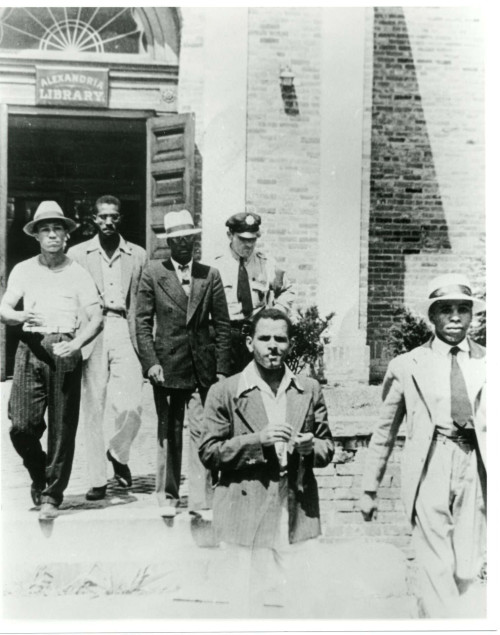
1939 Alexandria Library Sit-In - Encyclopedia Virginia
Alexandria’s first reading room, the Alexandria Library Company, was established in 1794 as a subscription service for the exclusive use of elite white men. Beginning in the nineteenth century, a few elite white women were allowed to use their husbands’ memberships for reading-room privileges, while others joined as members. The library excluded white members of the working class and Black Alexandrians.
encyclopediavirginia.org
Select five images that you think an upper elementary or middle school student growing up in another part of Virginia, or another state, needs to see to help understand the legacy of Samuel W. Tucker and others who championed access to public libraries for all citizens.
Write a caption with two to three sentences explaining how each image relates to Tucker’s legacy and the Alexandria Library Sit-In as part of the Civil Rights Movement. The images can be collected and organized digitally using Google Slides, Book Creator, or a platform of your choice, or printed and made into a paper booklet, as directed by your teacher.
Consider sharing your research with your school or public librarian, or ask them to display it for others to learn about the Alexandria Library Sit-In. If you live in another city or state, use the library and other local resources to explore the history of access to public libraries in your community. We would love to see your final projects or hear more about your research. Please ask your teacher to share it with us via email at: editor@newamericanhistory.org.
Your teacher may ask you to record your answers on an exit ticket.
Citations
“1939 ALEXANDRIA LIBRARY SIT-IN.” 1939 Alexandria Library Sit-In - Alexandria Library, September 2024. https://alexlibraryva.org/1939-sit-in
Grant, Tonya K. "The Road to School Desegregation." National Geographic Kids. Accessed April 22, 2026. https://kids.nationalgeographic.com/history/article/the-road-to-school-desegregation
Guernsey, Lisa. “A Project to Learn from and Illuminate the Library Sit-in of 1939.” New America, December 6, 2023. https://www.newamerica.org/education-policy/collections/the-1939-library-sit-in/
Mitchell-Powell, Contributor: Brenda. “1939 Alexandria Library Sit-In.” Encyclopedia Virginia, March 3, 2025. https://encyclopediavirginia.org/entries/1939-alexandria-library-sit-in/
"Plessy v. Ferguson." Oyez. Accessed April 23, 2026. https://www.oyez.org/cases/1850-1900/163us537.
“Quick Write/Quick Draw.” ReadWriteThink.org, 2007. https://www.readwritethink.org/sites/default/files/resources/lesson_images/lesson1053/quick_write_draw.pdf
“Robert Robinson Library - Alexandria Library” Last modified April 22, 2020. https://alexlibraryva.org/robert-robinson-library
“Samuel Tucker: Unsung Hero of the Civil Rights Movement.” City of Alexandria, VA, 2025. https://www.alexandriava.gov/museums/samuel-tucker-unsung-hero-of-the-civil-rights-movement
Silcox, Nancy Noyes. Samuel Wilbert Tucker: The story of a civil rights trailblazer and the 1939 Alexandria library sit-in. Fairfax, VA: History4All, Inc., 2014.
"The Montgomery Bus Boycott." National Park Service. Last modified September 21, 2022. https://www.nps.gov/articles/montgomery-bus-boycott.htm
WETA PBS “The 1939 Alexandria Library Sit-In Opened a New Front in the Civil Rights Movement” You Tube, August 21, 2024 video, 4:49 https://www.youtube.com/watch?v=Vz6CgRgNBVw