

This work by New American History is licensed under a Attribution-NonCommercial-ShareAlike 4.0 (CC BY-NC-SA 4.0) International License. Permissions beyond the scope of this license may be available at newamericanhistory.org.
Red Chicago - The Red Summer of 1919
The Future of America's Past
View Student Version
Standards
Common Core:RH.6-8.1: Cite specific textual evidence to support analysis of primary and secondary sources. RH.6-8.2: Determine the central ideas or information of a primary or secondary source; provide an accurate, objective summary of the source distinct from prior knowledge or opinions. RH.6-8.5: Describe how a text presents information (e.g., sequentially, comparatively, causally, visually, and graphically). RH.6-8.6: Identify aspects of a text that reveal an author's point of view, stance, or purpose (e.g. rhetorical language, inclusion or avoidance of particular facts, images, visuals, etc.). RH.6-8.7: Integrate visual information (e.g., in charts, graphs, photographs, videos, or maps) with other information in print and digital texts. RH6-8.8: Distinguish among fact, opinion, and reasoned judgment in a text. Identify and distinguish between a primary and secondary source on the same topic. RH.6-8.9: Analyze how two or more texts address similar themes or topics in order to build knowledge or to compare the approaches the authors take.
RH.9-10.1: Cite specific textual evidence to support analysis of primary and secondary sources, attending to such features as the time and place of publication, origin, authorship, etc. RH.9-10.2: Determine the central ideas or information of a primary or secondary source; provide an accurate summary of how key events or ideas develop within a text. RH.9-10.3: Analyze in detail a series of events described in a text; determine whether earlier events caused later ones or simply preceded them. RH.9.1-0.5: Describe how a text presents information (e.g., sequentially, comparatively, causally, visually, and graphically). RH.9-10.6: Compare the point of view of two or more authors for how they treat the same or similar topics, including which details they include and emphasize in their respective accounts. RH.9-10.7: Integrate and evaluate visual and technical information (e.g., in research data, charts, graphs, photographs, videos, or maps) with other information in print and digital texts. RH.9-10.9: Compare and contrast treatments of the same topic in several primary and secondary sources.
C3 Framework:D2.Civ.13.6-8. Analyze the purposes, implementation, and consequences of public policies in multiple settings.D2.Civ.13.9-12. Evaluate public policies in terms of intended and unintended outcomes, and related consequences.D2.Civ.14.6-8. Compare historical and contemporary means of changing societies, and promoting the common good.D2.Civ.14.9-12. Analyze historical, contemporary, and emerging means of changing societies, promoting the common good, and protecting rights.D2.Eco.1.6-8. Explain how economic decisions affect the well-being of individuals, businesses, and society.D2.Eco.1.9-12. Analyze how incentives influence choices that may result in policies with a range of costs and benefits for different groups.D2.Geo.2.6-8. Use maps, satellite images, photographs, and other representations to explain relationships between the locations of places and regions, and changes in their environmental characteristics.D2.Geo.2.9-12. Use maps, satellite images, photographs, and other representations to explain relationships between the locations of places and regions and their political, cultural, and economic dynamics.D2.Geo.4.6-8. Explain how cultural patterns and economic decisions influence environments and the daily lives of people in both nearby and distant places.D2.Geo.4.9-12. Analyze relationships and interactions within and between human and physical systems to explain reciprocal influences that occur among them.D2.Geo.8.6-8. Analyze how relationships between humans and environments extend or contract spatial patterns of settlement and movement.D2.Geo.8.9-12. Evaluate the impact of economic activities and political decisions on spatial patterns within and among urban, suburban, and rural regions.D2.Geo.9.6-8. Evaluate the influences of long-term human- induced environmental change on spatial patterns of conflict and cooperation.D2.Geo.9.9-12. Evaluate the influence of long-term climate variability on human migration and settlement patterns, resource use, and land uses at local-to-global scales.D2.His.4.6-8. Analyze multiple factors that influenced the perspectives of people during different historical eras.D2.His.4.9-12. Analyze complex and interacting factors that influenced the perspectives of people during different historical eras.
National Council for Social Studies:Themes: 1. Culture & 4. People, Places & Environments
National Geography Standards: Geography Standard 1: How to use maps and other geographic representations, geospatial technologies, and spatial thinking to understand and communicate information.Geography Standard 6: How culture and experience influence people’s perceptions of places and regions.
EAD FrameworkPrimary Theme: A people with contemporary debates & possibilitiesKEY CONCEPTS Explore the relationships between hard histories and contemporary debatesCultivate an understanding of personal interests, motivations, and decisions as civic agentsBuild strategies for learning about current events, issues, and debatesHSGQ7.3A. Why do particular current events and issues matter to you and how can you learn more about them?HSGQ7.3B. Are there moments, themes, or principles in United States history to which you can connect those issues?HSGQ7.3C. Have the American people ever faced a similar problem before? How did they solve it, or make it worse?CSGQ7.4A. Why do particular current events and issues matter to you and how can you investigate the issues or news stories that interest you?
RH.9-10.1: Cite specific textual evidence to support analysis of primary and secondary sources, attending to such features as the time and place of publication, origin, authorship, etc. RH.9-10.2: Determine the central ideas or information of a primary or secondary source; provide an accurate summary of how key events or ideas develop within a text. RH.9-10.3: Analyze in detail a series of events described in a text; determine whether earlier events caused later ones or simply preceded them. RH.9.1-0.5: Describe how a text presents information (e.g., sequentially, comparatively, causally, visually, and graphically). RH.9-10.6: Compare the point of view of two or more authors for how they treat the same or similar topics, including which details they include and emphasize in their respective accounts. RH.9-10.7: Integrate and evaluate visual and technical information (e.g., in research data, charts, graphs, photographs, videos, or maps) with other information in print and digital texts. RH.9-10.9: Compare and contrast treatments of the same topic in several primary and secondary sources.
C3 Framework:D2.Civ.13.6-8. Analyze the purposes, implementation, and consequences of public policies in multiple settings.D2.Civ.13.9-12. Evaluate public policies in terms of intended and unintended outcomes, and related consequences.D2.Civ.14.6-8. Compare historical and contemporary means of changing societies, and promoting the common good.D2.Civ.14.9-12. Analyze historical, contemporary, and emerging means of changing societies, promoting the common good, and protecting rights.D2.Eco.1.6-8. Explain how economic decisions affect the well-being of individuals, businesses, and society.D2.Eco.1.9-12. Analyze how incentives influence choices that may result in policies with a range of costs and benefits for different groups.D2.Geo.2.6-8. Use maps, satellite images, photographs, and other representations to explain relationships between the locations of places and regions, and changes in their environmental characteristics.D2.Geo.2.9-12. Use maps, satellite images, photographs, and other representations to explain relationships between the locations of places and regions and their political, cultural, and economic dynamics.D2.Geo.4.6-8. Explain how cultural patterns and economic decisions influence environments and the daily lives of people in both nearby and distant places.D2.Geo.4.9-12. Analyze relationships and interactions within and between human and physical systems to explain reciprocal influences that occur among them.D2.Geo.8.6-8. Analyze how relationships between humans and environments extend or contract spatial patterns of settlement and movement.D2.Geo.8.9-12. Evaluate the impact of economic activities and political decisions on spatial patterns within and among urban, suburban, and rural regions.D2.Geo.9.6-8. Evaluate the influences of long-term human- induced environmental change on spatial patterns of conflict and cooperation.D2.Geo.9.9-12. Evaluate the influence of long-term climate variability on human migration and settlement patterns, resource use, and land uses at local-to-global scales.D2.His.4.6-8. Analyze multiple factors that influenced the perspectives of people during different historical eras.D2.His.4.9-12. Analyze complex and interacting factors that influenced the perspectives of people during different historical eras.
National Council for Social Studies:Themes: 1. Culture & 4. People, Places & Environments
National Geography Standards: Geography Standard 1: How to use maps and other geographic representations, geospatial technologies, and spatial thinking to understand and communicate information.Geography Standard 6: How culture and experience influence people’s perceptions of places and regions.
EAD FrameworkPrimary Theme: A people with contemporary debates & possibilitiesKEY CONCEPTS Explore the relationships between hard histories and contemporary debatesCultivate an understanding of personal interests, motivations, and decisions as civic agentsBuild strategies for learning about current events, issues, and debatesHSGQ7.3A. Why do particular current events and issues matter to you and how can you learn more about them?HSGQ7.3B. Are there moments, themes, or principles in United States history to which you can connect those issues?HSGQ7.3C. Have the American people ever faced a similar problem before? How did they solve it, or make it worse?CSGQ7.4A. Why do particular current events and issues matter to you and how can you investigate the issues or news stories that interest you?
Teacher Tip: Think about what students should be able to KNOW, UNDERSTAND and DO at the conclusion of this learning experience. A brief exit pass or other formative assessment may be used to assess student understandings. Setting specific learning targets for the appropriate grade level and content area will increase student success.
Suggested Grade Levels: Middle School (6 - 8), High School (9 - 12)
Suggested Timeframe: Five 45-minute periods (approximately one period for each section of this learning resource).
Suggested Materials: Internet access via laptop, tablet, or mobile device, and a copy of Eve L. Ewing’s poem, “this is a map” (Provided with permission of the author/publisher for educational use only, no public re-posting permitted.)
Key Vocabulary
Afro-futurism: a movement in literature, music, art, etc., featuring futuristic or science fiction themes which incorporate elements of Black history and culture.
Boom: a period of great prosperity or rapid economic growth.
Color barrier: refers to an unspoken social code of racial segregation or discrimination, primarily used in the context of sports, education, and public service.
Commemoration: remembrance, typically expressed with a ceremony.
Commerce: the activity of buying and selling, especially on a large scale.
Commonplace: not unusual; ordinary.
Compelling: evoking interest, attention, or admiration in a powerfully irresistible way.
Coroner: an official who investigates violent, sudden, or suspicious deaths.
Curb: restrain or keep in check.
Dead Line: a boundary line, in which crossing means death.
Dignity: the state or quality of being worthy of honor or respect.
Din: a loud, unpleasant, and prolonged noise.
Discrimination: the unjust treatment of different categories of people, especially on the grounds of ethnicity, age, sex, or disability.
Dominance: power and influence over others.
Erupted: to force out or release usually suddenly and violently.
Fabricate: invent or concoct (something), typically with deceitful intent.
Gash: a long and deep slash, cut, or wound.
Grapple: engage in a close fight or struggle without weapons; wrestle.
Haint: a spirit or ghost, often malevolent, believed to cause harm or misfortune. The word is related to the word "haunt" and is used to describe an ill-meaning spirit.
Hemorrhage: internal bleeding
Heralding: a sign that something important is about to happen.
“Historical Amnesia”: refers to a selective forgetting or lack of awareness of past events, often within a collective or national context.
Hyperbole: exaggerated statements or claims not meant to be taken literally.
Immigrant: a person who comes to live permanently in a foreign country.
Incarceration: the state of being confined in prison; imprisonment.
Integrated: (of an institution, body, etc.) desegregated, especially racially.
Jeer: make rude and mocking remarks, typically in a loud voice.
Migrant: a person who moves from one place to another, especially in order to find work or better living conditions.
National Guard: (in the US) the primary reserve military force partly maintained by the states but also available for federal use.
Objective: (of a person or their judgment) not influenced by personal feelings or opinions in considering and representing facts.
Onslaught: a fierce or destructive attack.
Peddler: a person who sells illegal drugs or forbidden goods.
Performance Art: a broad category of art that utilizes live actions and bodily experiences to create artistic expressions.
Public Consciousness: refers to the collective awareness, beliefs, and attitudes of the general public, encompassing the shared understanding and knowledge of a particular country or community.
Quell: put an end to (a rebellion or other disorder), typically by the use of force.
Race Riots: a public outbreak of violence between two racial groups in a community.
Racial Lines: refers to the societal and legal barriers that divide people based on their racial or ethnic group, often leading to disparities and unequal treatment.
Rampant: (especially of something unwelcome or unpleasant), spreading unchecked.
Reconcile: restore friendly relations between.
Redlining: a discriminatory practice where financial institutions, like banks and insurance companies, deny or restrict services to certain neighborhoods, often based on the racial or ethnic makeup of the residents.
Resistance: the refusal to accept or comply with something; the attempt to prevent something by action or argument.
Restrictive covenant: an agreement in a deed to real estate (land/property) that restricts future use of the property, often enforceable against future owners. Restrictive covenants based on race were declared unconstitutional in 1949.
Segregation: the action or state of setting someone or something apart from others.
Sensationalize: (especially of a newspaper) present information about (something) in a way that provokes public interest and excitement, at the expense of accuracy.
Slain: kill (a person or animal) in a violent way.
Snuff: :a form of smokeless tobacco, either inhaled/snorted dry or orally by placing between the cheek and gum, called “dipping.”
Social Athletic Clubs: during the early 20th century, these neighborhood clubs were informal street groups made official by decree of local politicians; however, they were white gangs.
Stockyards: a large yard containing pens and sheds, typically adjacent to a slaughterhouse, in which livestock is kept and sorted.
Stolperstein: a ten-centimeter (3.9 in) concrete cube bearing a brass plate inscribed with the name and life dates of victims of Nazi extermination or persecution. It means 'stumbling stone' and is also a metaphor for 'stumbling block'.
Social Vulnerability Index: a tool used to assess the susceptibility of communities to the adverse effects of natural and man-made disasters.
Tableau: a group of models or motionless figures representing a scene from a story or from history.
References/ Context:
Jun Fujita was a first-generation Japanese-American photojournalist, photographer, silent film actor, and published poet in the United States.
The Black Belt/ Bronzeville are terms used to describe areas where African Americans were concentrated in the early 20th century, particularly in Chicago. "Black Belt" initially referred to a densely populated, narrow strip on Chicago's South Side. The term "Bronzeville" evolved from "Black Belt" and was popularized by black newspapers, referring to the area's thriving cultural and political scene.
The DuSable Black History Museum and Education Center, formerly the DuSable Museum of African American History, is a museum in Chicago that is dedicated to the study and conservation of African-American history, culture, and art named after Jean Baptiste Point du Sable.
The Defender newspaper is a historically significant African American newspaper founded in 1905 that played a crucial role in the Great Migration and the Civil Rights Movement.
Red Summer refers to the period of intense racial violence in the United States during the summer of 1919, marked by widespread white-on-black riots and lynchings.
Read for Understanding
Teacher Tips:
New American History Learning Resources may be adapted to a variety of educational settings, including remote learning environments, face-to-face instruction, and blended learning. These Learning Resources follow a variation of the 5Es instructional model, and each section may be taught as a separate learning experience or as part of a sequence of learning experiences. We provide each of our Learning Resources in multiple formats, including web-based and as an editable Google Doc for educators to teach and adapt selected learning experiences as they best suit the needs of your students and local curriculum. You may also wish to embed or remix them into a playlist for students working remotely or independently.
If you are teaching remotely, consider using videoconferencing to provide opportunities for students to work in pairs or small groups. Digital tools such as Google Docs or Google Slides may also be used for collaboration. Rewordify helps make a complex text more accessible for those reading at a lower Lexile level while still providing a greater depth of knowledge.
Teachers of Multilingual Learners may find that using sentence frames can help ELLs by providing a structured framework that can support them when expressing their ideas in complete sentences, whether they are speaking or writing. It serves as a scaffold for ELLs who struggle with grammar and/or vocabulary while promoting the use of academic language.
The S-I-T: Surprising, Interesting, Troubling protocol allows students to make their thinking visible using a structured table that can help them categorize their thoughts in a clear and precise manner. It also allows students to demonstrate their engagement with the text, as they note their reactions to various parts of the comic. A template is provided for you to modify as needed, for students to make a digital copy, or to print paper copies for your students as needed.
Exit tickets and graphic organizers allow students to reflect on their learning and enhance their communication skills. The Engage, Explore, and Elaborate sections of this learning resource include graphic organizers/exit tickets that use Give One/Get One, Sketchnotes, S-I-T Strategy, and Reciprocal Teaching Discussion Protocol for further engagement. More on Reciprocal Teaching is found here. Templates are linked within the lesson for you to modify, for students to copy, or to print paper copies for your students as needed.
Students will use Bunk excerpts, along with the Not Even Past: Social Vulnerability & the Legacy of Redlining maps, which contain step-by-step directions to navigate the maps on the website. It might be useful to allow students time to explore and familiarize themselves with the maps and website before the lesson, so they may gain a better understanding of the information provided.
Teachers may review this original map as needed and find further information on exploring both maps in the Teach About Redlining section of the original one. You may also wish to read more about the poet Eve Ewing and her take on teaching “original sin” in this interview from Rethinking Schools.
Read for Understanding (for students)
In “Red Chicago,” an episode of The Future of America’s Past, historian Ed Ayers commemorates the centennial of the 1919 race riots in Chicago—unrest fueled by systemic racism, especially in housing policies that confined Black residents to segregated neighborhoods. Ayers visits Chicago to engage with local artists and educators who are working to preserve the memory of these events as a way to prevent history from repeating itself. He meets poet and sociologist Eve Ewing, who discusses her poetry collection 1919, reflecting on the riots' lasting influence on the city. Ayers also speaks with performance artist Jefferson Pinder, museum educator Erica Griffin, and young community members creating memorials to honor this overlooked chapter of American history.
Engage:
How does art engage our senses to teach us about significant events in history?
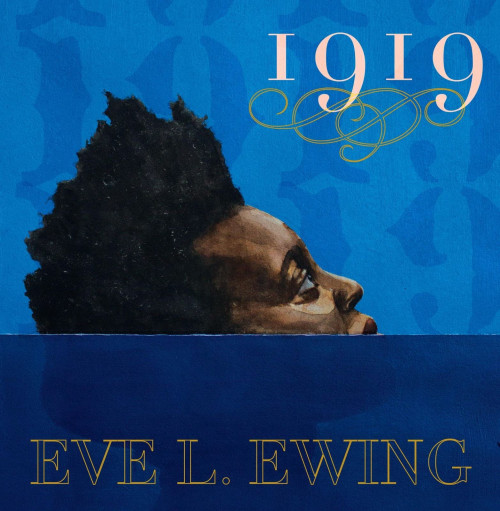
In “this is a map,” poet and sociologist Eve L. Ewing takes us on a journey through the history of Chicago, using poetry to explore the lasting effects of the 1919 race riots. Through her writing, Ewing helps us understand how these events shaped the city, especially the Black community, and how its effects are still felt today. The collection connects the past to the present, showing how racism, segregation, and violence continue to affect people’s lives. Ewing’s poems are not just about remembering history—they also encourage us to think about how we can create change in our own communities.
View the Introduction to the “Red Chicago” episode of the PBS series, The Future of America’s Past, hosted by historian Dr. Ed Ayers.
Next, view the segment, Erica Griffin: The Day that Changed Chicago – where Griffin provides context for the events of the summer of 1919.
Afterwards, take some time to view Understanding 1919 Through Poetry, a segment featuring poet Eve Ewing. Listen as she reads aloud, “this is a map,” and explains why she wrote it.
As you take time to more closely read this poem, jot down notes, annotate, and consider the images and feelings that come to mind throughout the story that the poem is trying to tell. You may make a digital copy of the poem to annotate using the “comment” feature and other tools (highlight, underline, etc), or your teacher may provide a paper copy.
Eve Ewing - This is a Map • New American History
At New American History, we’re committed to helping students see how current events take their shape from history. Our tools and resources are free and freely available to all educators, intended to uncover new ways to teach the past in light of the present.
resources.newamericanhistory.org
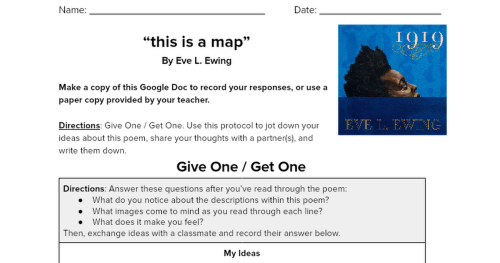
Answer these questions after you’ve read through the poem.
- What do you notice about the descriptions within this poem?
- What images come to mind as you read through each line?
- What does it make you feel?
Sentence Frames:
- I notice that the descriptions show _______.
- I think that _________.
- I can imagine __________.
- As I read, I picture ___________.
- This makes me feel __________ because _________.
Once you have finished jotting your observations, use the Give One/Get One Protocol to exchange ideas with a classmate (or two) and record their answer below using the graphic organizer provided. You may make a digital copy, or use a paper copy as directed by your teachers..
NAH Red Chicago - Eve Ewing: This Is a Map/Give One, Get One
Give One, Get One Graphic Organizer, to use with the poem, “this is a map,” By Eve L. Ewing
docs.google.com
Your teacher may ask you to record your answers on an exit ticket.
Explore:
How do maps tell the story of a city’s attitude towards racial differences?
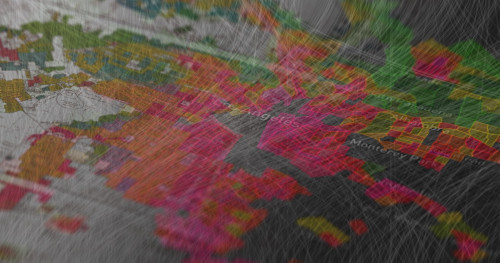
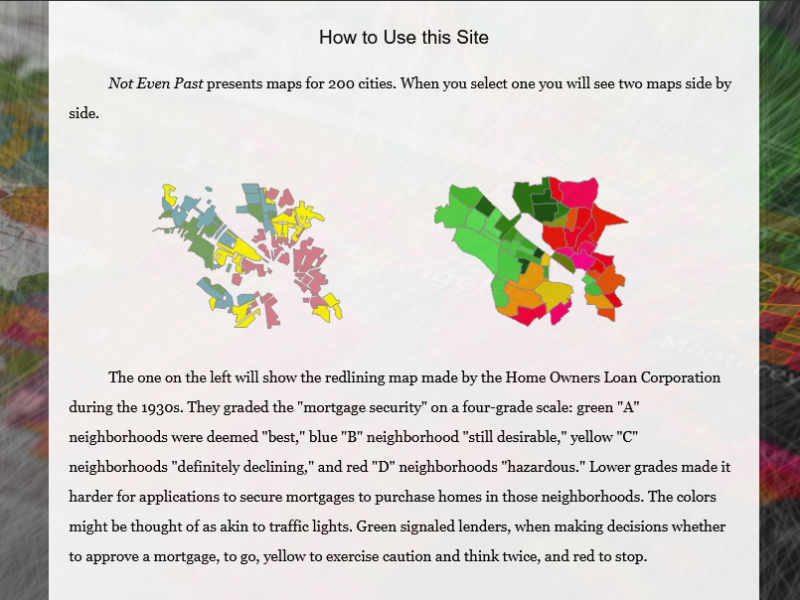
In the Red Chicago episode of The Future of America’s Past, we see that maps are more than just tools to show where things are—they can also show us how people were treated. These historic maps, from the New Deal era Home Owners' Loan Corporation, a government-sponsored program, are often called redlining maps. The maps were originally used to decide which neighborhoods were “good” or “bad” for banks to approve home loans.. These decisions were often based on the race, religion, or ethnicity of the people who lived there. That means the maps didn’t just show where people lived—they showed where people were allowed to live, and who got access to things like home ownership, good schools, and safer neighborhoods. These maps tell the story of how cities like Chicago treated people differently because of their race, religion, or ethnicity, and how this unfair treatment was built into the way neighborhoods were planned and governed.
View the segment, Jefferson Pinder: A Living Memorial to Eugene Williams. The practice of restrictive covenants is explored through the explanation of the HOLC maps.
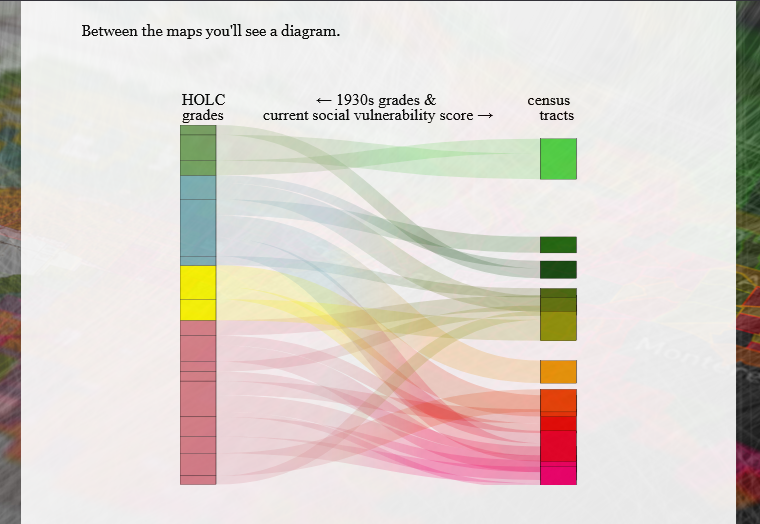
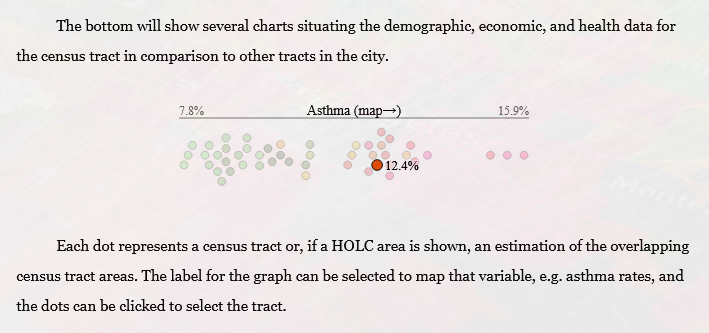
Take some time to explore the digital mapping project, Not Even Past: Social Vulnerability & the Legacy of Redlining, from the Digital Scholarship Lab at the University of Richmond. Look for patterns around the various neighborhoods of Chicago.
Not Even Past: Social Vulnerability and the Legacy of Redlining
Not Even Past maps redlining maps from the 1930s with maps of health disparities today, showing enduring contours of marked inequality in American cities over the past century.
dsl.richmond.edu
1/3
After you have explored Chicago, return to the homepage for the map and select a different city to explore, perhaps one near your school or another place you have lived or visited.
Rewatch the segment, The Day that Changed Chicago, with Erica Barnes, now that you know more about redlining.
Then view the segment Newspapers Reveal and Obscure the Riots. and consider how the invisible racial lines drawn throughout Chicago, as well as redlining, affected the racial tensions within the city during the summer of 1919.
Stop & Think/ Comprehension:
- What is redlining, and how was it used in cities like Chicago?
- Why were certain neighborhoods outlined in red? Who made those decisions?
- How did redlining affect families who lived in those neighborhoods?
Sentence Frames:
- Redlining meant __________; in cities like Chicago, it was used to ____________.
- Certain neighborhoods were outlined in red because ____________.
- These decisions were made by _____________________.
- Redlining affected families who lived in those neighborhoods because ___________.
Take notes using the S-I-T Strategy of the information you are most interested in exploring.
Your teacher may provide a paper copy, or you may make a copy of this graphic organizer using the link provided above to record your responses.
NAH S-I-T: Surprising, Interesting, Troubling
Make a digital copy of this chart to record your thoughts, ideas, and answers, or use a copy provided by your teacher. What was SURPRISING? What was INTERESTING? What was TROUBLING?
docs.google.com
Your teacher may ask you to record your answers on an exit ticket.
Explain:
How do maps and historical narratives come together in this episode to tell the story of Chicago?
Use the reciprocal teaching roles below to focus on reading comprehension strategies—these include predicting, questioning, clarifying, and summarizing—to have a discussion-based analysis of the “Red Chicago” episode.
Choose Roles in Small Groups: Each of you will choose one of the following roles:
- Questioner – Asks thoughtful questions about how the episode uses maps or narratives (e.g., “Why do you think the map was shown at this point?” or “What message does this story tell us about race in Chicago?”)
- Summarizer – Briefly explains the main points of a segment (e.g., “This part showed a map of redlined neighborhoods and explained how that affected Black families.”)
- Clarifier – Helps explain terms, context, or visual elements (e.g., “Redlining meant denying loans to people based on race—this map shows that happening in Chicago.”)
- Connector – Makes connections to other parts of the episode, other topics they’ve learned, or current events (e.g., “This reminds me of how some neighborhoods today still have fewer resources because of these past policies.”)
Rotate roles in later rounds so that you may each have the opportunity to try each one.
Segment the Episode: You may re-watch selected segments from the episode to review the content as needed, then use your time to discuss each one using the protocol.
Suggested segments:
- Introduction segment – how the episode frames Chicago’s racial past
- Jefferson Pinder – map analysis, visual of the Chicago HOLC redlining map with explanation
Whole-Class Reflection: After small-group discussions, come together to reflect:
- What did you learn from how maps and stories work together?
- Which role helped you understand the episode best? Why?
- How does this way of telling history affect how we see Chicago—and the people who live there?
Sentence Frames:
- I learned that ______ and _______.
- The role that helped my understanding the best was _____ because _______.
- This way of telling history affects the way I see Chicago and the people who live there by __________.
Complete this sentence as a final reflection:
“Maps and narratives together help tell the story of Chicago by _____ .”
Your teacher may ask you to record your answers on an exit ticket.
Elaborate:
How has redlining shaped Chicago’s neighborhoods, and how can performance art help us remember and respond to that history?
Performance art is all about becoming living storytellers. A tableau is like a frozen picture made with your bodies– a type of performance art. It’s silent and still, but it tells a story—just like a photo or a painting. In groups, you’ll create a frozen scene that shows how redlining affected people’s lives in Chicago, or how performance art helps us remember that history. Think of it as history in motion—paused for a moment.
View this segment from Red Chicago with Peter Cole and Franklin Cosey-Gay, Public Art as Activism , to learn more about the role of public art as a form of activism.
You will be divided into small groups to create a tableau. You will use the “Small Group Activity” handout to follow step-by-step how to create your own tableau and reflect on how this activity affects your understanding of historical events.
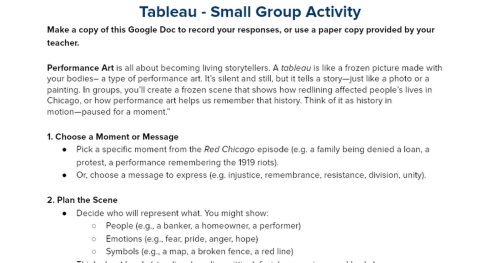
NAH Red Chicago - Tableau Directions
Make a copy of this Google Doc to record your responses, or use a paper copy provided by your teacher. Performance Art is all about becoming living storytellers. A tableau is like a frozen picture made with your bodies– a type of perform...
docs.google.com
Your group will:
1. Choose a Moment or Message
- Pick a specific moment from the Red Chicago episode (e.g. a family being denied a loan, a protest, a performance remembering the 1919 riots).
- Or, choose a message to express (e.g. injustice, remembrance, resistance, division, unity).
2. Plan the Scene
- Decide who will represent what. You might show:
- Think about levels (standing, kneeling, sitting), facial expressions, and body language.
3. Set the Scene (Practice)
- Practice getting into your positions quickly and silently.
- Hold your tableau for about 5–10 seconds.
- Make sure everyone’s body is telling part of the story.
4. Share with the Class
- Groups present their tableau.
- Optional: One member steps out and briefly explains: “Our tableau shows _______. We wanted to highlight ______ because _______.”
5. Reflect
After all groups present, discuss:
- What emotions or ideas came through the strongest?
- How did this help us understand redlining or the way we remember history through performance?
Your teacher may ask you to record your answers on an exit ticket.
Extend:
What role do we play in the collective memory and remembrance of significant historical events?
Redlining showed us how neighborhoods were divided based on race—and how unfair housing policies kept those divisions in place for years. But even before redlining maps, racial segregation caused tension and violence. You’ve read about how the Chicago Race Riot of 1919 was one of the worst race riots in U.S. history.
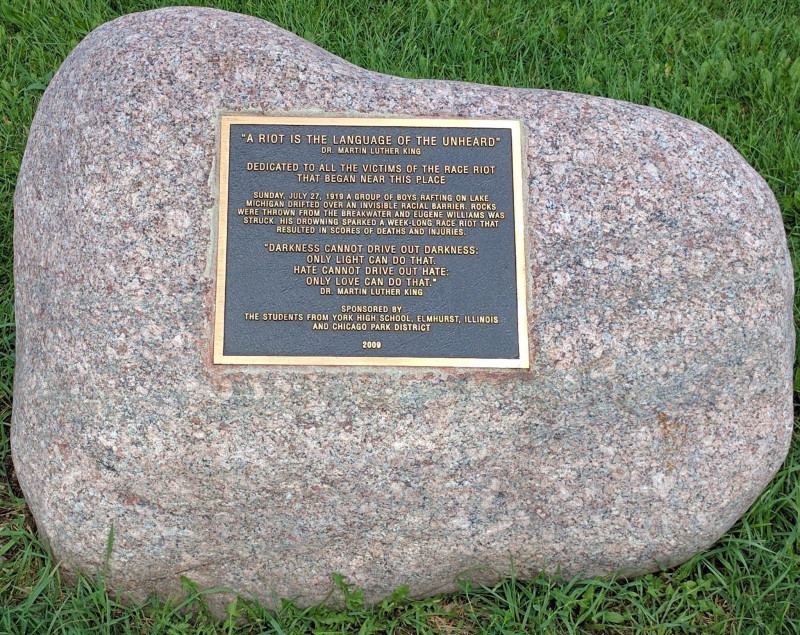
Now, people in Chicago are working to remember those events through the Commemoration Project, and asking: How can we face the hard parts of our history and learn from them today?
Read this Bunk excerpt, “The Chicago Race Riot of 1919 Commemoration Project.”
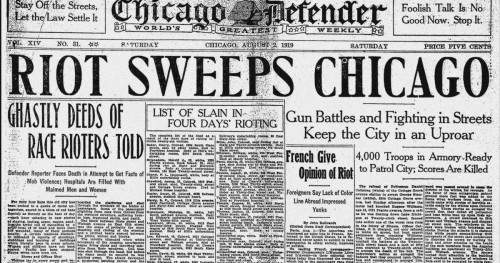
The Chicago Race Riot of 1919 Commemoration Project
Why are Chicago’s race riots of 1919 overlooked in the city’s collective memory? A new project tells the stories of the 38 killed, and the legacy of racism in the U.S.
www.bunkhistory.org
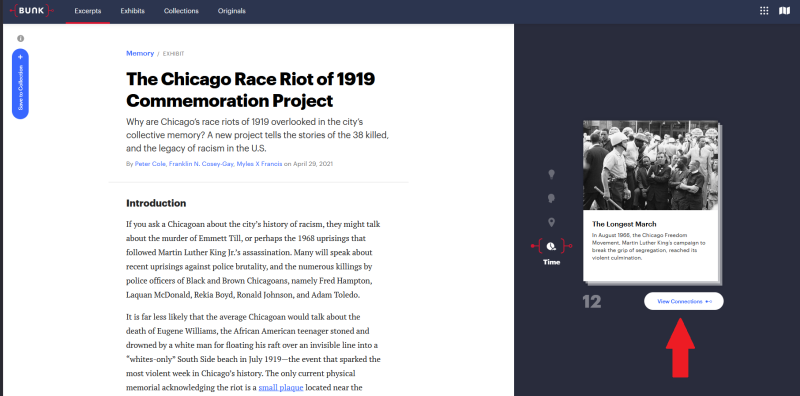
Select the “View Connections” button to explore more excerpts as connected in Bunk. You may choose different icons as you explore. Note the associated tags that connect each excerpt to another. Explore one or more tags.
Consider and discuss the following questions:
- How are the causes of the 1919 Chicago Race Riot connected to redlining and housing segregation?
- Why do you think it’s important to remember events like the 1919 Race Riot today?
- How does the CRR19 Project use public spaces (like sidewalks and streets) to tell stories, just like maps do?
- What lessons can we learn from how people responded to racism and violence in the past?
- If you were creating your own commemoration project, what story would you want to tell, and how would you tell it?
Sentence Frames:
- The causes of the 1919 Chicago Race Riot are connected to redlining and housing segregation because _____________.
- I think it’s important to remember events like the 1919 Race Riot today because ________.
- The way the CRR19 Project uses public spaces (like sidewalks and streets) to tell stories is similar to maps because ____________.
- Some of the lessons we can learn from the way people responded to racism and violence in the past are ____________ and ______________.
- If I was creating my own commemoration project, I would want to tell the story of ________ because ___________. I would tell it by _____________.
Explore some of the Bunk connections. You might also check out some personal stories/interviews – narratives from residents or experts.
Your teacher may ask you to record your answers on an exit ticket.
Citations:
Chicago Race Riot of 1919 Commemoration Project. "The History." Last modified January 21, 2022. Accessed June 7, 2025. https://chicagoraceriot.org/history/the-riot/
Ewing, Eve L. “this is a map,” in 1919 (Chicago: Haymarket Books, 2019)
Facing History and Ourselves. “What is the Give One, Get One Strategy?” February 20, 2015. Accessed March 23, 2025. https://www.facinghistory.org/resource-library/give-one-get-one
Keller, Keeley, “10 Reasons You Should Use Sentence Frames In Your Classroom.” TeachingChannel.com. September 9, 2022. Accessed March 23, 2025. https://www.teachingchannel.com/k12-hub/blog/10-reasons-you-should-use-sentence-frames-in-your-classroom/#:~:text=1)
Politzer, Ben. "Reciprocal Teaching," Reading Rockets, last modified April 25, 2019. Accessed June 8, 2025. https://www.readingrockets.org/strategies/reciprocal_teaching.
“S-I-T: Surprising, Interesting, Troubling.” Facing History & Ourselves. Accessed June 17, 2024. https://www.facinghistory.org/resource-library/s-i-t-surprising-interesting-troubling
The Future of America's Past. “Red Chicago.” Directed by Eduardo Montes-Bradley. Hosted by Edward L. Ayers. Season 2, Episode 2. PBS, 2021. Streaming video, 26:47. https://www.pbs.org/video/red-chicago-qgeaww/
The Teacher Toolkit, “Exit Ticket.” Accessed March 23, 2025. https://www.theteachertoolkit.com/index.php/tool/exit-ticket
Citations:
Chicago Race Riot of 1919 Commemoration Project. "The History." Last modified January 21, 2022. Accessed June 7, 2025. https://chicagoraceriot.org/history/the-riot/
Ewing, Eve L. “this is a map,” in 1919 (Chicago: Haymarket Books, 2019)
Facing History and Ourselves. “What is the Give One, Get One Strategy?” February 20, 2015. Accessed March 23, 2025. https://www.facinghistory.org/resource-library/give-one-get-one
Keller, Keeley, “10 Reasons You Should Use Sentence Frames In Your Classroom.” TeachingChannel.com. September 9, 2022. Accessed March 23, 2025. https://www.teachingchannel.com/k12-hub/blog/10-reasons-you-should-use-sentence-frames-in-your-classroom/#:~:text=1)
Mapping Inequality. DSL.Richmond.Edu. Accessed August 2, 2025. https://dsl.richmond.edu/panorama/redlining
Not Even Past: Social Vulnerability and the Legacy of Redlining. DSL.Richmond.Edu. Accessed April 2, 2025. https://dsl.richmond.edu/socialvulnerability/Politzer, Ben. "Reciprocal Teaching," Reading Rockets, last modified April 25, 2019. Accessed June 8, 2025. https://www.readingrockets.org/strategies/reciprocal_teaching.
“S-I-T: Surprising, Interesting, Troubling.” Facing History & Ourselves. Accessed June 17, 2024. https://www.facinghistory.org/resource-library/s-i-t-surprising-interesting-troubling
The Future of America's Past. “Red Chicago.” Directed by Eduardo Montes-Bradley. Hosted by Edward L. Ayers. Season 2, Episode 2. PBS, 2021. Streaming video, 26:47. https://www.pbs.org/video/red-chicago-qgeaww/
The Teacher Toolkit, “Exit Ticket.” Accessed March 23, 2025. https://www.theteachertoolkit.com/index.php/tool/exit-ticket
View this Learning Resource as a Google Doc