

This work by New American History is licensed under a Attribution-NonCommercial-ShareAlike 4.0 (CC BY-NC-SA 4.0) International License. Permissions beyond the scope of this license may be available at newamericanhistory.org.
All History is Local: The Museum That Heals
Key Vocabulary
Baby Boomers - demographic group of Americans born between the end of World War II and the early sixties
Bias - prejudice in favor of or against one thing, person, or group compared with another, usually in a way considered to be unfair
Cambodia - country that borders Vietnam to its west
Colony - a country or area under the full or partial political control of another country, typically a distant one, and occupied by settlers from that country
Communism - a political and economic system in which all property is publicly owned and each person works and is paid according to their abilities and needs
Dissonance - a state of mental conflict caused by opposing ideas in your head at once
Domino Theory - policy idea first proposed by President Harry S. Truman and continued by Dwight D. Eisenhower that believed that communism would spread in Southeast Asia and damage United States interests globally
Heckling and jeers - negative comments and insults
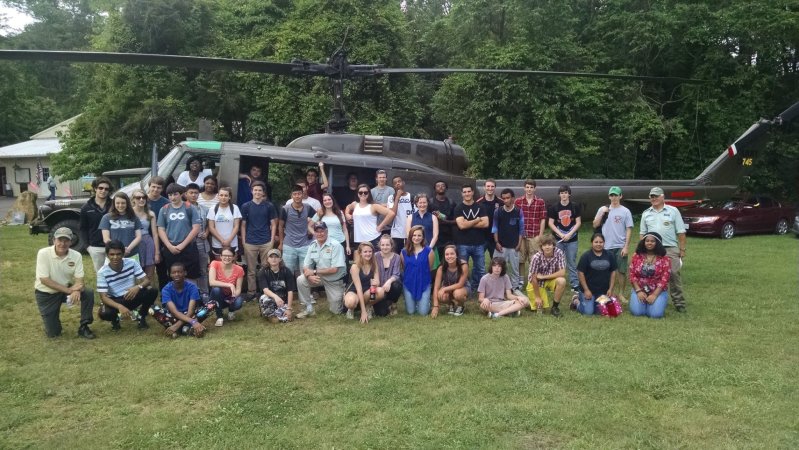
Huey helicopter - nickname for the Bell UH-1 Iroquois model helicopter that was a main mode of transport for American troops during the Vietnam War
Laos - country that borders Vietnam to its southwest
Lyndon B. Johnson - 36th United States. president, from 1963 to 1969; it was his administration’s decision to start sending combat troops to Vietnam in 1965
Op/Ed piece - a type of writing in which the author expresses opinion and builds an argument, sometimes with a call to action at the end
Oral History - a field of study and a method of gathering, preserving, and interpreting the voices and memories of people, communities, and participants in past events
Slights – insults caused by people not respected you
Viet Cong guerrilla fighters - a South Vietnamese communist group, officially called the National Liberation Front, that fought against the South Vietnamese government and its United States ally and wanted to reunite Vietnam under communist rule
Vietnam War - (1955–1975) a lengthy and bitter cold war-era conflict in Asia that pitted the communist government of North Vietnam against South Vietnam and its principal ally, the United States
Read for Understanding
When you are frustrated by slights that upset you early in life, how do you channel that resentment into something positive and productive? And how do you work through the dissonance that comes with criticizing an effort that you’re also proud of?
Meet the United States military veterans of the Vietnam War who have confronted these questions in Central Virginia over the last 20 years, using a backyard museum to share their stories. A converted barn shed became a site of storytelling, a dose of medicine for Vietnam veterans seeking to heal from, or reconnect with their service in Southeast Asia in the 1960s.
What can we learn from these veterans? And how might you plan your own oral history interview to learn from the stories of older adults in your community?
Engage:
Why were Vietnam War veterans treated poorly when they returned?
The United States government’s involvement in Vietnam started in 1950 with President Harry S. Truman sending military advisors to aid the French, who were fighting a war to maintain Vietnam as their colony. The involvement escalated in 1965, when President Lyndon Johnson first sent combat troops to stop communist North Vietnam from overtaking the non-communist South.
Independently read this Bunk excerpt to understand more of the context of the war: "Studying the Vietnam War.”
Studying the Vietnam War
How the scholarship has changed.
www.bunkhistory.org
Then answer these questions to check your understanding:
- Why have historians increased their interest in studying the Vietnam War in recent years?
- What has changed over the last 30 years in the way historians understand the war?
- What does the new research tell us about the governments of North and South Vietnam before and during the war?
Share your answers with a partner and then discuss as a class.
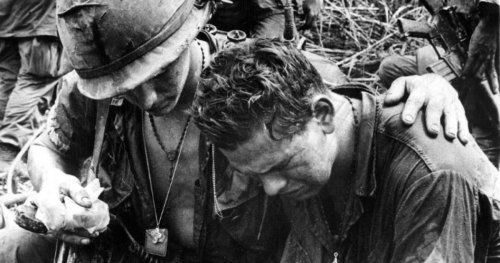
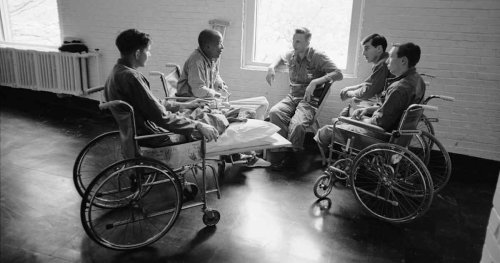
American soldiers returning home from their deployment in Vietnam in the 1960s and 1970s did not receive ticker-tape parades the way soldiers who served in World War II did. Instead, some faced heckling and jeers when they arrived back stateside. Or they were met with silence from their families and an eagerness to move on from a war that America did not want, and did not win.
Vietnam veteran and author Karl Marlantes explained his experience returning home:
“Coming home from Vietnam was almost as traumatic as the war itself. For years, no one mentioned Vietnam. We were friends with a young couple, it was only after 12 years that the two wives were talking, found out we had both been Marines in Vietnam. Never said a word about it. And the whole country was like that. It was so divisive. It's like living in a family with an alcoholic father, "Shh, we don't talk about that." Our country did that with Vietnam, and it's only been recently that the Baby Boomers have been asking, "What happened? What happened?"
QUOTE ANALYSIS – Analyze the quote independently using the See-Think-Wonder thinking routine:
- What do you notice in the quote (key words, tone)?
- Why do you think American society didn’t want to talk about the Vietnam War after it ended?
- What follow-up questions do you have to better understand the quote?
Share your responses as a group of three or four. Nominate a record keeper and record your answers in this graphic organizer.
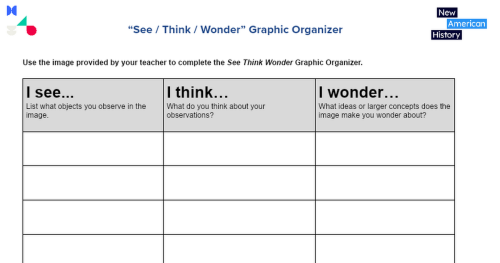
NAH "See / Think / Wonder" Graphic Organizer
Use the image provided by your teacher to complete the See Think Wonder Graphic Organizer.
docs.google.com
Then nominate a group reporter and discuss as a class.
After the quote discussion independently read “Why Were Vietnam War Vets Treated Poorly When They Returned?”
Why Were Vietnam War Vets Treated Poorly When They Returned? | HISTORY
American soldiers returning home from Vietnam often faced scorn as the war they had fought in became increasingly unpopular.
www.history.com
As you read use the Claim-Support-Question thinking routine. Your teacher may provide a paper copy or allow you to make a digital copy of this graphic organizer to help you capture your thoughts.
NAH "Claim-Support-Question" Graphic Organizer
Use the image provided by your teacher to complete the See Think Wonder Graphic Organizer.
docs.google.com
Respond to these questions after reading the article:
- What were the major reasons that Vietnam vets were treated poorly when they returned home?
- What examples does the article mention to support these reasons?
- What questions do you still have?
Share your responses in the same group of three or four. Nominate a different group reporter and discuss as a class.
Your teacher may ask you to record your answers on an exit ticket.
Explore:
How was a backyard barn shed converted into a Vietnam War museum?
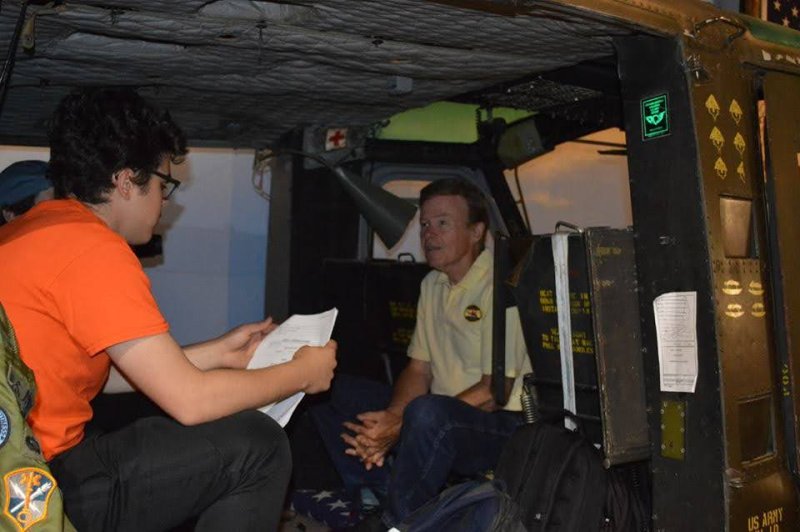
Vietnam veteran Craig LaMountain, an auto mechanic from New York, retired to Ruckersville, Virginia. In a barn shed next to his farm equipment, he stored his Huey helicopter and other Vietnam artifacts that he had used when his history-teacher cousin asked him to give guest lectures at schools on Long Island, New York. The helicopter was headed for the junkyard in 1996, but the U.S. government gave it to Craig, with the understanding that he would use it as a teaching aid. Over the years, he added to his vehicle collection to enhance his presentation. Craig felt the Vietnam veteran was not being fully seen and respected by American society, so he started visiting schools to take his message directly to the next generation. “The Vietnamese soldier is a human, not a stereotype,” his lectures stated.
On your own, read Chapter 1 of “The Museum That Heals” here. After you read, use the Word-Phrase-Sentence thinking routine. Independently complete this graphic organizer.
- Choose a word that captured your attention or that you thought was powerful.
- Choose a phrase that moved or intrigued you.
- Choose a sentence that you believe captured the core idea of the text.

resources.newamericanhistory.org
NAH "Word / Phrase / Sentence" Graphic Organizer
Use the reading linked in the lesson to complete the organizer.
docs.google.com
Then work in small groups to answer these questions:
- Why did LaMountain create his museum?
- Why did other Vietnam vets volunteer to work at the museum?
- How did the museum help reunite and heal the veterans?
Nominate a group member to report out. Discuss the questions as a class.
Your teacher may ask you to record your answers on an exit ticket.
Explain:
Who are the caretakers of the museum?
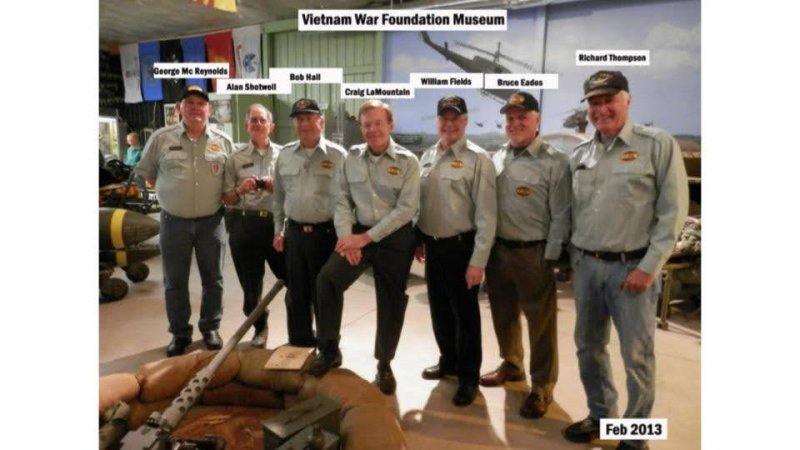
Vietnam veteran Craig LaMountain opened his backyard museum in 2009. Other local Vietnam veterans pitched in to remodel the shed, contributing their building skills and their personal artifacts. Many also led guided tours for school groups. Three such men were Dick Thompson, Alan Shotwell, and Bruce Eades.
Your teacher will assign you to a partner. Each pair will choose two of the three excerpts from the Vietnam veterans. Independently, read their stories in “The Museum That Heals”. Then, as a pair, answer the questions below.
- Story of Dick Thompson, the pilot – Ch. 2 of “The Museum That Heals”
- Story of Alan Shotwell, the artist – Ch. 3 of “The Museum That Heals”
- Story of Bruce Eades, the healer – Ch. 4 of “The Museum That Heals”
For each Veteran’s story you read, answer these questions:
- Why did he join the military?
- What did he do in Vietnam?
- What was life like for him when he returned from Vietnam?
- What lessons did he learn from his experiences as a United States soldier in Vietnam?
Then, with your partner, identify and explain two similarities between the two men’s stories.
Nominate a partner to report out. Discuss the stories as a class.
Your teacher may ask you to record your answers on an exit ticket.
Elaborate:
What can veterans teach us about war?
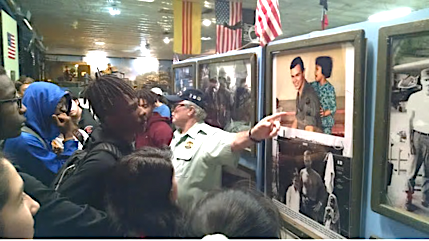
President Lyndon B. Johnson and the United States military first committed combat troops to Vietnam in 1965 to counter the Domino Theory and stop communism in Southeast Asia. The United States withdrew its forces in 1973, and the war ended two years later with the communist North overtaking the South. More than 58,000 American soldiers had died in the war. At least 250,000 South Vietnamese troops died, as did more than 1 million North Vietnamese soldiers and Viet Cong guerrilla fighters. About 2 million civilians in North and South Vietnam were also killed, as well as thousands more in neighboring Laos and Cambodia. In short, the war had a devastating impact.
So what can this war teach us? Historians, public officials past and present, and political pundits offer wide-ranging commentary and perspectives. But the voices of those who fought can be especially instructive.
Use this graphic organizer to read comments from each of the four veterans from “The Museum that Heals” that express lessons they learned. Summarize and analyze their quotes independently or with a partner, as directed by your teacher.
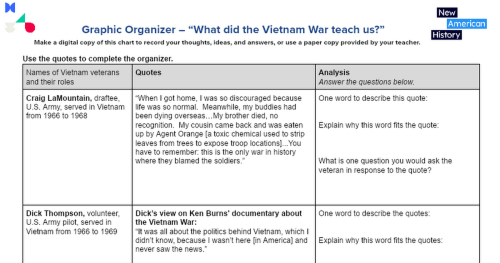
NAH Museum That Heals - Veteran Quote Organizer
Use the quotes to complete the organizer.
docs.google.com
Then, with a partner, discuss patterns among the four commentaries:
- To what extent are they similar?
- What might account for the differences in their views?
Your teacher may ask you to record your answers on an exit ticket.
Extend:
How can oral history projects humanize and enliven a study of the past?
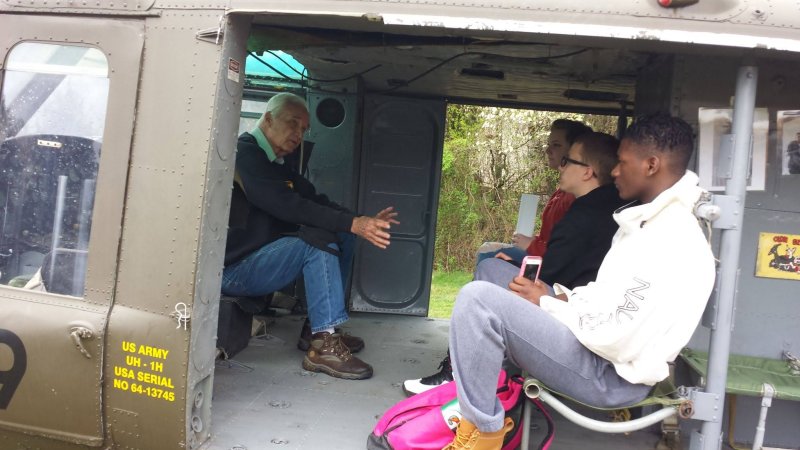
By listening to respected older adults within our communities who have lived through challenges, we receive a local history lesson and words of wisdom that are invaluable. Whether they are military veterans, civil rights fighters, or matriarchs or patriarchs of families, these wise folks also need help. They need the help of a listener’s ear: to know that their strivings and struggles were not in vain.
To organize these listening sessions, oral history projects can be powerful. But where does one even start when wanting to plan them? For veteran interviews, local American Legion and Veterans of Foreign Wars chapters can be great groups to work with. And local museums, historical societies, and state humanities councils can also help you organize sit-down interviews around a historical theme.
First, skim this article about collecting Oral Histories. Answer: What are three tips that you learned for leading an interview?
Hearing History from Those Who Lived It: Collecting Oral Histories in the Classroom - Social Studies
Social Studies Hearing History from Those Who Lived It: Collecting Oral Histories in the Classroom Blog
www.socialstudies.com
PROJECT TASK: Interview an older adult who has made a contribution to your community, such as local veterans, government officials, activists, or family members. First, write out a series of questions that build a story. Then, arrange the meeting and record the session. (NOTE: Your teacher will help you arrange a safe place and time to meet the community member, whether in the school library or other community space.) Lastly, create a final product that captures the stories that your older adult shared with you.
View this three-minute how-to video from a Smithsonian historian on conducting oral histories.
Review the following resources to assist you in your interviews:
For an interview with a military veteran:
For an interview with a community leader or family member:
Reflection questions after the interview:
- How does the interview fit within a broader historical context?
- What was the bias of the interview subject?
- How might your point of view have influenced the questions and answers?
Ideas for Final Products:
- Write a magazine article or Op/Ed piece
- Produce a podcast episode (tips to help are here)
- Create a Memory Box from a shoebox or other small container. (example here)
- Design a monument
Your teacher may ask you to record your answers on an exit ticket.
Citations:
Byrne, Hannah. “Oral History at Home — Five Easy Steps.” Smithsonian Institution Archives YouTube. Accessed December 30, 2025. https://www.youtube.com/watch?v=pxrkkhLExxw
Ciampaglia, Dante A.. “Why Were Vietnam War Vets Treated Poorly When They Returned?” History.com, November 8, 2018, updated May 28, 2025. Accessed October 22, 2026. https://www.history.com/articles/vietnam-war-veterans-treatment
Deegan, Matt. The Museum That Heals: How Vietnam war veterans used a backyard barn shed to share stories of a complicated past. Charlottesville, VA: Glorybound, 2025.
Giannotti, Keri A. “Hearing History from Those Who Lived It: Collecting Oral Histories in the Classroom.” SocialStudies.com, May 20, 2025. https://www.socialstudies.com/blog/hearing-history-from-those-who-lived-it-collecting-oral-histories-in-the-classroom/?srsltid=AfmBOoqBCzTI01HSWJgfP7cPxLcQOZhhNE9v8BcNI_qn6Vo9sqhdzMv3
Library of Congress. Veterans History Project Field Kit. Accessed December 30, 2025. https://www.loc.gov/static/programs/veterans-history-project/documents/vhp-field-kit-complete.pdf
Monument Lab. “Monument Lab Field Trip Kit.” Accessed December 30, 2025. https://data.monumentlab.com/monument-lab/assets/koc89365r1w8o044
Niekrasz, E.J. “How to Do Oral History.” Smithsonian Institution Archives, May 7, 2020. https://siarchives.si.edu/history/how-do-oral-history
PBS. “The Vietnam War: A Film by Ken Burns & Lynn Novick.” Accessed December 30, 2025. https://www.pbs.org/kenburns/the-vietnam-war
Project Zero. “PZ’s Thinking Routines Toolbox.” PZ’s Thinking Routines Toolbox | Project Zero. Accessed December 30, 2025. https://pz.harvard.edu/thinking-routines
Smithsonian Center for Folklife and Cultural Heritage. “The Smithsonian Folklife and Oral History Interviewing Guide.” Accessed December 30, 2025. https://folklife.si.edu/the-smithsonian-folklife-and-oral-history-interviewing-guide/smithsonian
Tate, Rachel. “GHS Veterans Project - 📝teacher Toolkit.” GHS Veterans Project Teacher Toolkit. Accessed December 30, 2025. https://sites.google.com/glnd.k12.va.us/ghsveteransproject/teacher-toolkit
Teach and Create, “Memory Box Activity.” May 29, 2013. https://teachandcreate.wordpress.com/2013/05/29/memory-box-activity/